
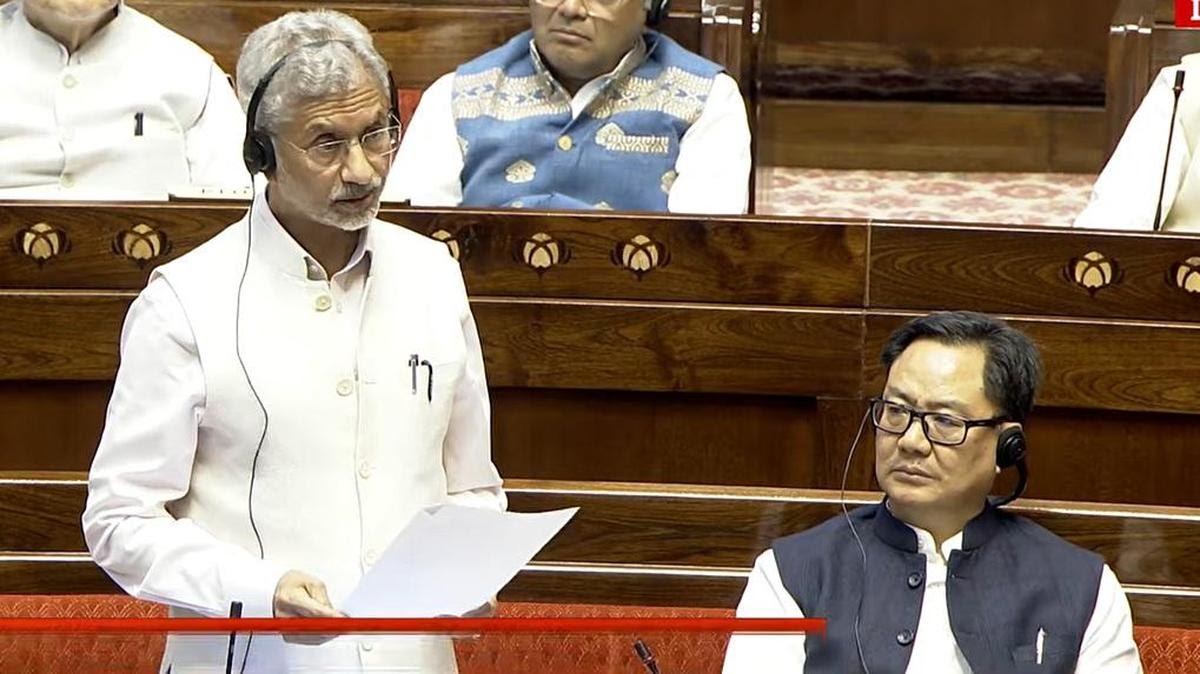
Source The Hindu
NEW DELHI — In a high-stakes address to Parliament on Monday, External Affairs Minister S. Jaishankar reinforced India’s stance on the escalating West Asia conflict, calling for an immediate return to “dialogue and diplomacy” while underscoring that the safety of nearly 10 million Indian nationals remains the government’s “paramount” priority.
Speaking in the Rajya Sabha during the second leg of the Budget Session, Jaishankar provided a comprehensive briefing on the volatility that has gripped the region since hostilities intensified on February 28. The Minister stated that Prime Minister Narendra Modi is “personally monitoring” the situation as it threatens global energy security and regional stability.
A Call for De-escalation
Jaishankar emphasized that India has maintained a consistent policy of restraint since the onset of the current crisis, which has seen direct military engagements between Israel, the United States, and Iran.
“India is in favour of peace and urges a return to dialogue and diplomacy,” Jaishankar told the House. “We advocate de-escalation, restraint, and ensuring the safety of civilians. The sovereignty and territorial integrity of all states in the region must be respected.”
The Minister noted that the conflict has “deteriorated significantly” and spread to several nations, impacting normal life and economic activities across the Gulf.
Protecting the Indian Diaspora
With approximately one crore (10 million) Indian citizens living and working in Gulf nations, and several thousand students and professionals in Iran, the government has moved into a proactive evacuation and assistance phase.
Evacuation Efforts: Over 67,000 Indian nationals have already crossed international borders to return home as of March 9.
Mission Status: The Indian Embassy in Tehran remains “fully operational” and on high alert to assist those remaining.
Travel Advisories: Formal advisories remain in place, urging Indians to avoid non-essential travel to the region and encouraging those present to register with local missions.
Economic and Energy Stakes
Beyond the humanitarian crisis, Jaishankar warned of “serious supply chain disruptions.” The Gulf region is a critical trading partner for India, with annual trade accounting for nearly $200 billion.
The Minister highlighted that India’s energy security is intricately tied to the stability of the Strait of Hormuz. Any prolonged instability could lead to a climate of global economic uncertainty, particularly regarding oil and gas supplies.
Parliamentary Friction
Despite the gravity of the Minister’s statement, the session was marked by turbulence. Opposition MPs staged a walkout in the Rajya Sabha, demanding a full-fledged discussion rather than a suo motu statement. Union Minister Kiren Rijiju criticized the disruption, accusing the opposition of “irresponsible” behavior during a national security crisis.
As the conflict continues to evolve, the Cabinet Committee on Security (CCS) remains in active session to coordinate India’s multi-ministerial response to the regional fallout.









