Source TOI
PATNA — March 30, 2026
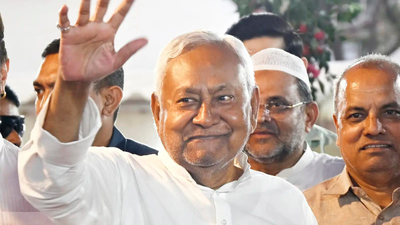
In a move that signals the definitive sunset of a two-decade era, Bihar Chief Minister Nitish Kumar resigned from the State Legislative Council (MLC) today. The resignation, submitted on the final day of a 14-day constitutional deadline following his election to the Rajya Sabha, effectively sets the stage for Bihar’s first-ever BJP Chief Minister.
While Kumar can technically remain in the top post for up to six months under Article 164(4) of the Constitution, the atmosphere in Patna suggests a transition is imminent. The JD(U) supremo’s departure to Delhi marks a seismic shift for a party that has pivoted Bihar’s politics around a single man since 2005.
A Calculated Transition
Nitish Kumar’s move to the Upper House of Parliament is a rare “full circle” in Indian politics. Having served as a Union Minister, an MLA, an MLC, and now a Rajya Sabha member, the 75-year-old leader is framing his exit as the fulfillment of a long-held personal ambition.
However, the political reality is more complex. Following the NDA’s landslide victory in the 2025 Assembly elections, the BJP emerged as the senior partner with 89 seats to JD(U)’s 85. For the first time, the “Big Brother” in the alliance is looking to claim the CM’s chair, a post they have historically conceded to Kumar to maintain the state’s delicate caste equations.
Can JD(U) Hold Its Ground?
The big question looming over the Bihar Secretariat is whether the JD(U) can survive as a cohesive force without “Nitish-on-the-throne.”
The Succession Plan: Nitish’s 50-year-old son, Nishant Kumar, recently joined the party and is being groomed as the political heir. While some party insiders view him as a “shock absorber” to prevent a split, others are pushing for him to be named Deputy CM to maintain the party’s influence.
Voter Sentiment: Political observers note that Kumar’s core base—Extremely Backward Classes (EBCs) and Mahadalits—may feel “orphaned” by his move to Delhi. Former MP Anand Mohan recently warned that this shift could alienate voters who gave the mandate specifically to see Nitish as CM until 2030.
The BJP’s “Madhya Pradesh” Strategy
The BJP central leadership, led by Vinod Tawde, is already in Patna to oversee the transition. Speculation is rife that the party may skip established veterans for a “surprise” face, similar to their recent experiments in Madhya Pradesh and Rajasthan.
Top Contenders for the CM Post:
| Candidate | Current Role | Strength |
| :— | :— | :— |
| Samrat Choudhary | Deputy CM | Strong Kushwaha (OBC) leader; aggressive face of Bihar BJP. |
| Nityanand Rai | Union MoS (Home) | Close to the central leadership; influential Yadav face. |
| Dilip Kumar Jaiswal | State Minister | Three-time MLC with deep organizational roots. |
The Road Ahead
As Nitish Kumar prepares to take his oath in the Rajya Sabha on April 10, the JD(U) finds itself at a crossroads. For years, the party was the “hinge” of Bihar politics, swinging between the BJP and the RJD. With Nitish moving to a national role and the BJP eyeing the driver’s seat, the JD(U) must now prove it is more than just a “one-man show” or risk being absorbed by its larger ally.
For Bihar, the “Nitish Era” hasn’t just ended; it has evolved into a high-stakes experiment in power-sharing where the JD(U) is, for the first time, truly the junior partner.