Source TOI
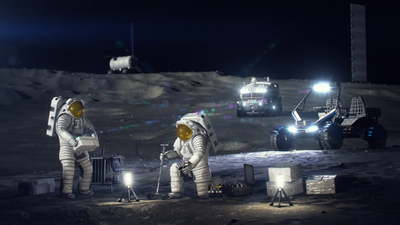
WASHINGTON — Fresh off the heels of the historic crewed Artemis II flyby, NASA has officially unveiled a massive, three-phase architectural roadmap to construct a sprawling, permanent lunar settlement. The space agency has benched its previous “Gateway” orbital space station plans in favor of an aggressive, direct-to-surface construction initiative at the moon’s South Pole.
According to NASA officials, the planned outpost will ultimately stretch across hundreds of square miles, marking the dawn of an entirely new era of deep-space human habitation.
Over the Moon: From Temporary Visits to Permanent Real Estate
Speaking at a major Moon Base event at NASA Headquarters, newly appointed NASA Administrator Jared Isaacman laid out the stakes for the upcoming decade of engineering.
“The Moon Base will be America’s and humanity’s first outpost on another celestial world. We will go for the science, for all we stand to gain from an economic and technological perspective… and to prepare for where we will inevitably go next.”
— Jared Isaacman, NASA Administrator
The pivot away from an orbital gateway allows NASA to channel funding directly into surface infrastructure, significantly accelerating timelines for long-term survival experiments. The South Pole region was specifically chosen because its deep, permanently shadowed craters contain massive reserves of water ice—a critical resource that can be harvested for drinking water, oxygen, and liquid hydrogen rocket fuel.
The Master Blueprint: Three Phases to Colonization
The project is structured into three distinct phases stretching into the 2030s:
**Phase 1 (2026–2029) | The Robotic Wave: Starting this autumn, NASA kicks off a series of uncrewed scout missions to map the terrain, test dust-mitigation tech, and deliver initial cargo.
**Phase 2 (2029–2032) | Breaking Ground: This phase marks the arrival of heavy infrastructure, including surface nuclear reactors for power grids, specialized communication networks, and the first permanent habitable modules.
**Phase 3 (2032+) | The Permanent Outpost: Humanity achieves a semi-permanent presence. The base transitions into a fully operational research facility with routine crew rotations, demanding an astonishing 38 tons of supply shipments annually just for maintenance.
Heavy Machinery: High-Tech Buggies and Hopping Drones
To manage a base of this magnitude, NASA has awarded nearly $1 billion in commercial contracts to private space companies to build the heavy machinery of the future.
Advanced Lunar Terrain Vehicles (LTVs)
NASA has tapped two American firms, Astrolab and Lunar Outpost, to build next-generation “Moon buggies” capable of traveling up to 9 to 14 mph. These vehicles will be versatile: they can be driven manually by astronauts, controlled remotely by operators back on Earth, or left to navigate the rugged terrain entirely autonomously. NASA aims to have at least one LTV idling on the surface before human boots touch down in late 2028.
The “MoonFall” Drone Fleet
Because the South Pole’s landscape is famously jagged and treacherous, traditional rovers can’t go everywhere. To solve this, NASA is working with Firefly Aerospace to deploy four unique hopping drones by 2028. These drones will leap across deep chasms and hazardous craters to photograph inaccessible terrain and effectively “mark the perimeter” of the expansive base.
Immediate Next Steps: The 2026 Inception
The physical construction of this sci-fi infrastructure begins immediately. NASA announced three critical uncrewed foundational flights launching later this year:
Moon Base I (Fall 2026): Utilizing Blue Origin’s Blue Moon Mark 1 Endurance lander, this mission will touch down on the Shackleton Connecting Ridge. It will deploy specialized cameras to analyze how rocket exhaust blasts lunar dust and a laser array to act as a precise GPS beacon for future missions.
Moon Base II (Late 2026): Astrobotic’s Griffin lander will carry over 1,100 pounds of heavy equipment, including a prototype rover designed to test how cargo can be routinely shuffled across the surface.
Moon Base III (Late 2026): Utilizing an Intuitive Machines lander, this mission will carry international payloads from Europe and South Korea to study “lunar swirls”—mysterious, highly magnetic bright patches on the moon’s surface.
With human astronaut landings slated to resume as early as late 2028 under the Artemis program, the next few years will transform Earth’s closest neighbor into a bustling, off-world construction zone.
“Then,” noted NASA Moon Base program executive Carlos Garcia-Galan, “we will be able to say, ‘Hey, we are permanently here, and we are not giving it up.'”