
Source New Indian Express
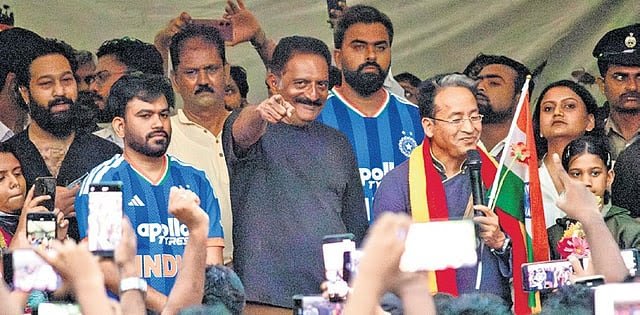
BENGALURU — Defying heavy downpours, a dense crowd of students, parents, and civil society activists gathered at Freedom Park on Sunday evening to protest systemic failures in India’s national examination system. The demonstration, spearheaded by the youth-led citizens’ collective Cockroach Janta Party (CJP), focused its fury squarely on Union Education Minister Dharmendra Pradhan, demanding his immediate resignation over high-profile examination paper leaks and evaluation scandals.
The Bengaluru agitation marks a key expansion of the CJP’s escalating nationwide campaign, which has already staged massive demonstrations in cities like Delhi, Pune, Hyderabad, Lucknow, and Amritsar.
Prominent Voices Converge at Freedom Park
The protest drew heavy star power, featuring prominent high-profile figures including veteran actor Prakash Raj and acclaimed Ladakhi climate activist and educationist Sonam Wangchuk, both standing alongside CJP founder Abhijeet Dipke.
Demonstrators held handmade posters—including a notable one carried by a 10-year-old girl that read “I am 10 But I still have my RIGHTS. #FAIREXAMS”—and chanted slogans accusing the NDA government of extreme apathy toward the country’s youth.
Why the name “Cockroach Janta Party”?
Organizers revealed that the group sarcastically adopted the moniker after being dismissively referred to as “cockroaches” during court proceedings related to their petitions exposing systemic flaws. “When we try to raise our voice, when we try to expose this broken system, we are called cockroaches,” founder Abhijeet Dipke told the crowd.
“Youngsters Forced to Give Up Their Lives”
Addressing the crowd, Abhijeet Dipke launched a scathing critique of the political establishment, focusing heavily on the tragic human cost of the ongoing national exam failures, including the alleged National Eligibility cum Entrance Test (NEET) paper leaks and irregularities in the CBSE’s digital marking systems.
“There were lakhs of students who could have become doctors in the future,” Dipke said. “The very students who could have gone on to save the lives of others were forced to give up their own lives. I don’t think there can be anything more shameful than this for the country.”
Dipke further challenged the government’s narrative of fear and division, claiming authorities use communal rhetoric to distract from infrastructural collapses. He declared that if speaking up against exam scams leads to legal retaliation, he would gladly “be the first one to go to jail.”
Demands for Systemic Accountability
The guest speakers expanded the scope of the protest, arguing that the flaws in the testing agencies are a reflection of a deeper political rot.
Prakash Raj targeted Prime Minister Narendra Modi’s prolonged silence on the recurring paper leak scandals, stating, “Our Prime Minister is the most educated… Then why are you silent?” He further added, “Uncles and aunties over the retirement age are looting and ruining the country, with no accountability or responsibility for their actions.”
Sonam Wangchuk focused on the psychological environment of the nation, warning against a culture of intimidation. “If people have to live in fear, they might as well have been born in China,” Wangchuk stated. He clarified that the CJP’s agitation is strictly a citizen awareness movement rather than a bid for partisan political power, emphasizing that “India is suffering not just from a fiscal deficit, but a trust deficit.”
As the evening concluded, organizers vowed to sustain their protests across major state capitals until the Union Ministry provides structural updates, independent judicial probes, and guarantees absolute data safety for future exam cycles.









