
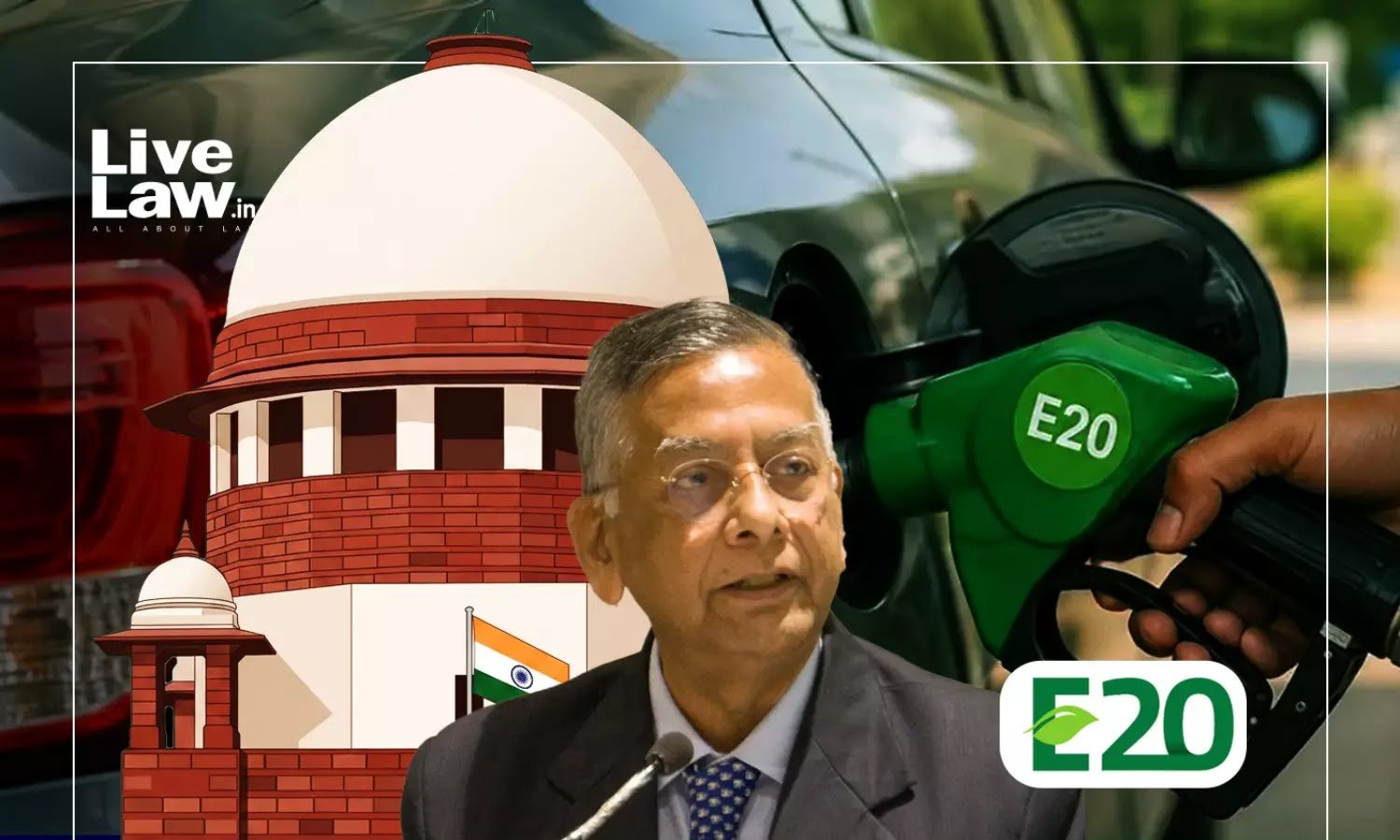
Source Live law
NEW DELHI — The Union Law Ministry and the Office of the Attorney General (AG) for India have strongly refuted widespread media reports claiming that the central government described its 20% Ethanol Blended Petrol (E20) initiative as an “ongoing experiment” before the Supreme Court.
In an official statement released through the Press Information Bureau (PIB), the government termed the media coverage “completely false,” clarifying that the national fuel-blending mandate is a well-established policy rather than a trial.
Clarification on Supreme Court Submissions
The controversy erupted following news reports on a Supreme Court hearing regarding an ethanol allocation dispute. Media outlets had quoted Attorney General R. Venkataramani as telling the bench that the E20 blending rollout was an “ongoing experiment” whose results and impact would only become clear by next year.
As those reports circulated online, they sparked intense debates on social media platforms, with vehicle owners and public commentators questioning why a national fuel policy was being framed as a trial on the public.
Responding to the backlash, the AG’s office explicitly denied making any such statements:
“At no stage was any submission made that the Government’s Ethanol Blended Petrol (EBP) Programme or the E20 blending programme is an ‘experiment’. These reports are completely false and do not reflect anything even close to the actual submissions made before the Hon’ble Court.”
The Legal Context: Ethanol Allocation Disputes
The AG was appearing before the Supreme Court on behalf of state-owned Bharat Petroleum Corporation Limited (BPCL). BPCL is currently challenging a Karnataka High Court directive that ordered oil marketing companies (OMCs) to revisit and potentially enhance ethanol supply allocations to a specific distillery for the 2025–26 supply year.
According to the Law Ministry, the AG’s actual arguments focused entirely on legal logistics and safeguarding national policy continuity, rather than the viability of the fuel itself.
Preventing Conflicting Verdicts: The AG informed the top court that multiple identical petitions concerning ethanol allocation to Dedicated Ethanol Plants are currently pending across various state High Courts.
Consolidation of Cases: The central government is moving transfer petitions to aggregate all these scattered lawsuits under the Supreme Court. This is intended to establish a uniform legal interpretation and avoid a chaotic web of parallel, conflicting judgments.
Ensuring Fuel Supply Consistency: The government emphasized that consolidating these cases is vital for a quick legal resolution, ensuring that contractual disputes do not disrupt the steady supply of ethanol required to maintain 100% nationwide availability of E20 fuel.
Court Orders Status Quo
Taking note of the Attorney General’s actual submissions, the Supreme Court directed that the proposed transfer petitions be filed. Crucially, the apex court ordered a status quo on the current ethanol allocations for the 2025–26 Ethanol Supply Year, preventing the high court order from destabilizing current supply chains.
The Ministry of Law and Justice concluded its statement by urging media organizations to exercise due diligence and report judicial proceedings with absolute accuracy, particularly when reporting on critical national policy initiatives.









