
Source ITP.Net
SAN FRANCISCO — In a major shift for conversational artificial intelligence, OpenAI has officially launched GPT-Live, a new generation of voice models designed to erase the awkward pauses of traditional AI interactions. The new technology powers a complete overhaul of ChatGPT Voice, bringing it closer to the fluid, continuous dynamics of a natural human conversation.
The rollout marks a major architectural departure from previous voice assistants, introducing capabilities that allow the AI to listen, speak, and process information simultaneously.
Breaking the Turn-Based Barrier
For years, interacting with voice-based AI felt distinctly mechanical: the user would speak, the AI would wait for a definitive pause of silence, process the audio, and then generate a response. OpenAI’s new full-duplex architecture changes that paradigm completely.
Because the model now processes incoming audio and generates outgoing speech at the same time, the interaction operates without fixed turns. ChatGPT can now:
Acknowledge mid-thought: Toss in casual verbal cues like “mhmm,” “yeah,” or “got it” while you are actively speaking.
Handle natural pauses: Wait patiently while you gather your thoughts, rather than jumping in prematurely during a brief silence.
Accept seamless interruptions: Pivot instantly if you speak up mid-sentence, adjust its pace on command, or simply listen without feeling compelled to answer immediately.
According to OpenAI CEO Sam Altman, the shift alters how users may interact with the AI moving forward. “GPT-Live feels magical and ‘real,'” Altman shared in a post on X. “I have always preferred typing to talking to an AI, now I think that’s going to shift.”
Background Brainpower: Delegating to Frontier Models
One of the most notable engineering feats of GPT-Live is how it handles heavy computational tasks without stalling the conversation. OpenAI has effectively separated continuous vocal interaction from deep cognitive reasoning.
When a user asks a complex question that requires a web search or deep analysis, GPT-Live doesn’t freeze. Instead, it hands the task off to a frontier model behind the scenes—utilizing GPT-5.5 at launch—to do the heavy lifting. While the background model searches the web or processes the data, GPT-Live keeps the conversation going with the user, seamlessly integrating the final answer into the spoken flow once it’s ready.
Enhanced Visuals and New Features
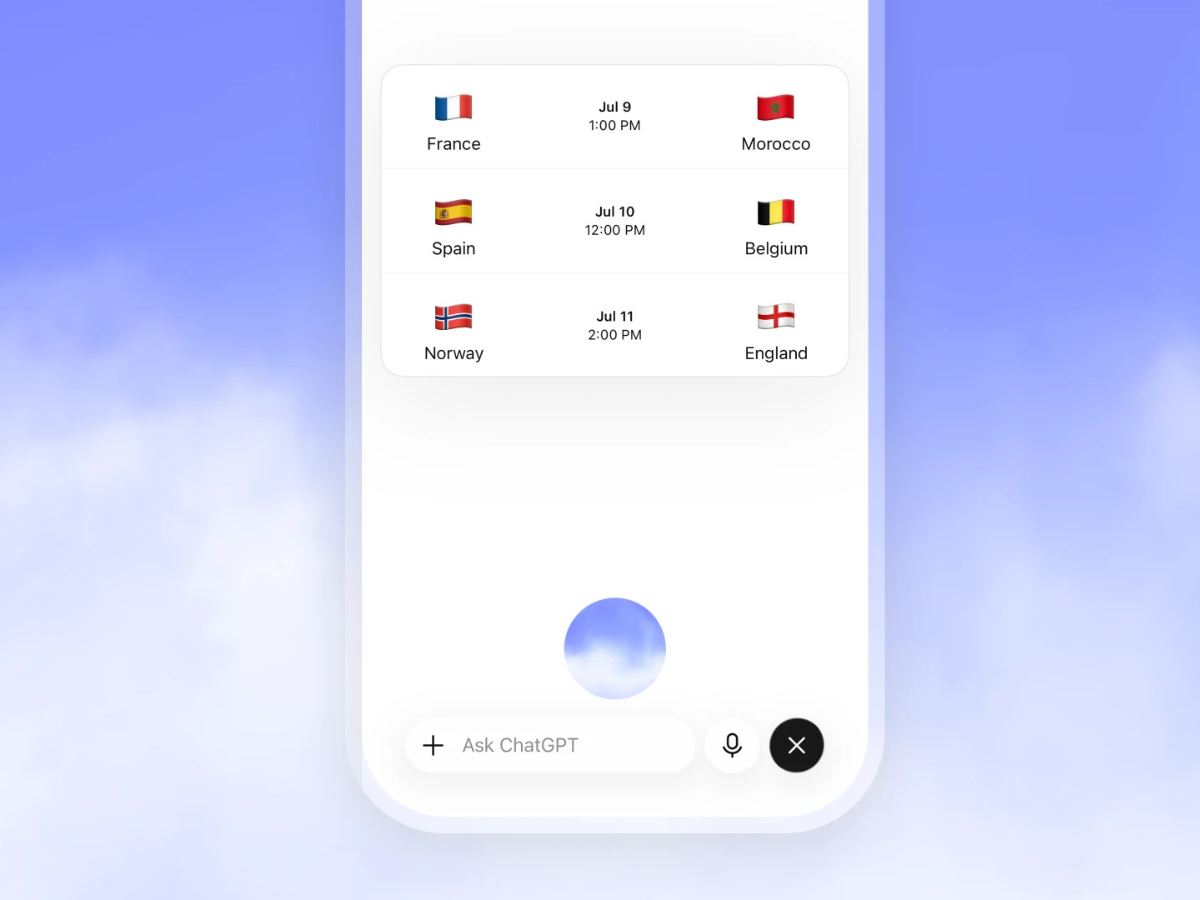
The updated ChatGPT Voice experience isn’t strictly auditory. As the AI speaks, the interface now streams the text response alongside it and can display visual response cards for data-heavy topics like weather updates, stock prices, and sports scores.
Additionally, the full-duplex setup enables continuous live translation. Two people speaking entirely different languages can converse in real time through the app without having to manually stop, restart, or prompt the interface between sentences.
Safety and Safety Guardrails
With more lifelike audio capabilities comes the need for heightened safety measures. OpenAI noted it has implemented robust audio-native evaluations specifically targeting high-risk areas such as emotional reliance, self-harm, and violence.
The system is equipped to guide users toward safe resources or automatically terminate a voice session in severe scenarios. Furthermore, the company built strict protections for teenage accounts and integrated safeguards that restrict the model to a curated set of remastered, predefined voices—preventing the system from being used to impersonate real people.
Global Availability
The feature is rolling out globally across web browsers as well as the ChatGPT iOS and Android mobile apps.
GPT-Live-1 is now the default voice experience for paid subscribers on the Go, Plus, and Pro tiers, while free users have access to a lighter, optimized version called GPT-Live-1 mini. While screen sharing and video capabilities are not supported in this initial live release, OpenAI confirmed those features are slated for a future update.









