
Source Hindustan Times
NEW DELHI — India has formally requested the United States to withdraw a proposed 12.5% punitive tariff on Indian goods, arguing that unilateral trade penalties should be shelved in favor of ongoing bilateral trade negotiations.
The dispute stems from a Section 301 investigation launched by the Office of the United States Trade Representative (USTR) regarding forced labor concerns. In public hearings held in Washington, Indian officials and industry leaders pushed back strongly, labeling the U.S. report factually and legally flawed.
A “Flawed” Methodology
Brij Mohan Mishra, Joint Secretary in India’s Department of Commerce, stated during the USTR panel hearing that India takes the eradication of forced labor seriously, treating it as both a constitutional obligation and an international commitment.
However, India objected heavily to how the U.S. handled the investigation, pointing out that Washington grouped 46 entirely different economies into a single category without providing country-specific or sector-specific evidence linking actual Indian exports to forced labor.
“A mere absence of a forced labor import prohibition, without meeting the evidentiary basis of other statutory requirements, cannot be construed as ‘unreasonable’ within the meaning of Section 301,” the Indian submission stated, asserting that the U.S. failed to prove that Indian policies create an unfair competitive advantage at the expense of American industries.
Specific export bodies also defended their sectors. Shreyans Gupta, First Secretary at the Indian Embassy in Washington, representing the Agricultural and Processed Food Products Export Development Authority (APEDA), explicitly rejected U.S. claims regarding Indian rice imports. Gupta pointed out that India’s rice imports are minimal—amounting to less than 3% of what India exports to the U.S.—and pass through rigorous domestic regulatory checks that permit exports only from registered, compliant mills.
Supply Chains at Risk
Indian industry giants have rallied behind the government’s stance, warning that the proposed 12.5% tariff would backfire on the American economy.
The Federation of Indian Chambers of Commerce and Industry (FICCI) and the Confederation of Indian Industry (CII) both submitted statements warning that broad, sweeping tariffs ignore established corporate compliance systems. They emphasized that the tariffs would inevitably drive up costs for:
US manufacturers relying on Indian components
Importers and retailers
American consumers already facing inflation pressures
The Push for Bilateral Talks
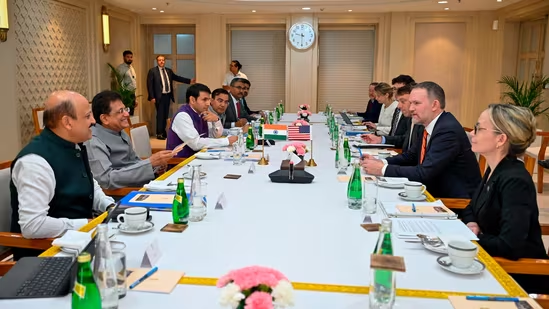
The current friction comes at a delicate time for U.S.-India commercial ties. While the two nations have been actively working toward a major Bilateral Trade Agreement (BTA) to dramatically expand their trading footprint, unilateral measures threaten to stall momentum.
New Delhi has reiterated that it remains fully open to constructive dialogue and consultations, but firmly maintains that the USTR should rescind its current investigation and handle any trade-related discrepancies within the existing framework of bilateral negotiations rather than through unilateral market disruptions. The USTR is currently reviewing stakeholder feedback before making a final determination on the proposed tariffs.









