
Source AI
WASHINGTON / NEW DELHI — In the latest restructuring of American trade policy, the United States has unveiled new Section 301 tariff slabs targeting roughly 60 global economies. Under directives issued by President Donald Trump, the Office of the United States Trade Representative (USTR) announced duties ranging between 10% and 12.5%.
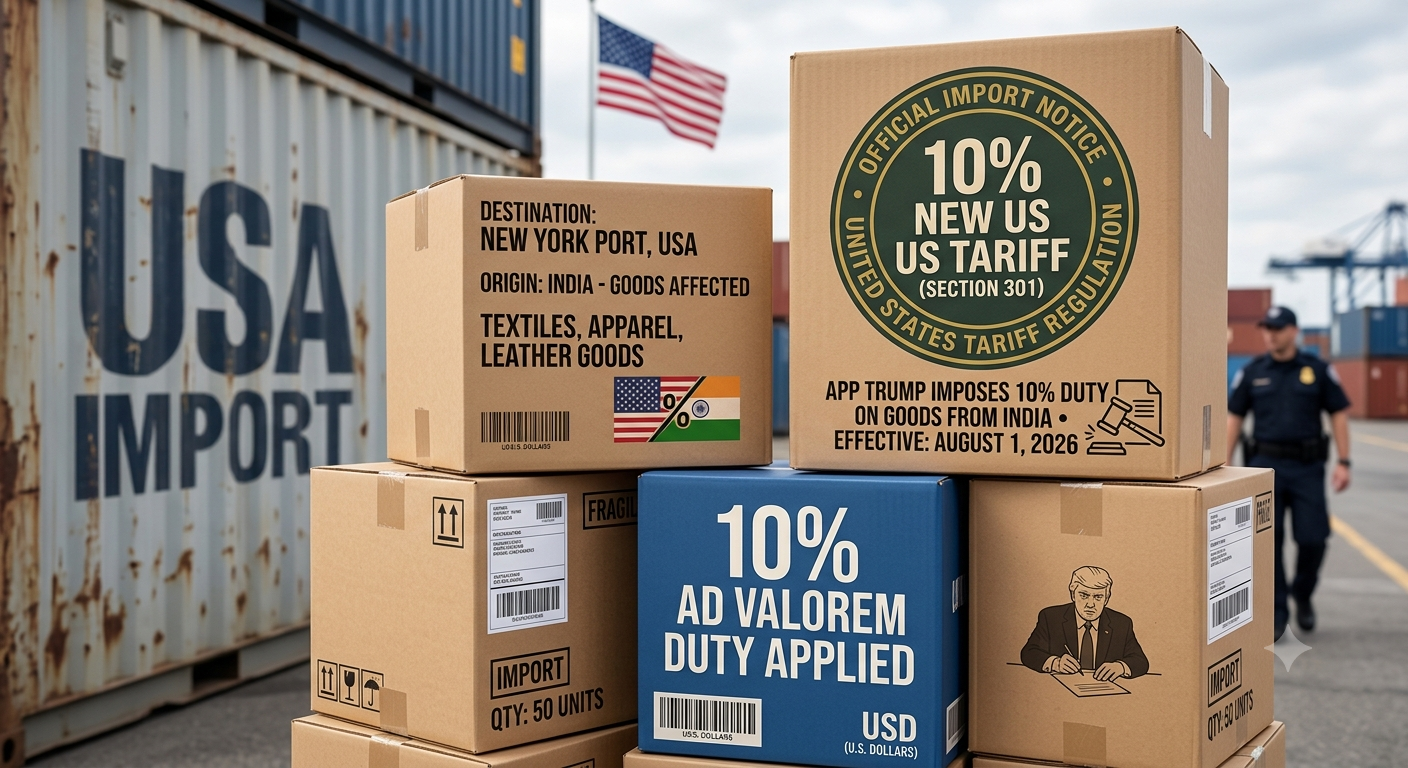
India has been placed in the lower 10% tariff category alongside 16 other nations, avoiding a steeper 12.5% rate after intensive bilateral discussions and recent domestic regulatory updates. The new measure replaces an expiring temporary 10% global surcharge, establishing a more permanent legal framework for Washington’s trade strategy.
Strategic Shift Following Forced Labour Investigation
The latest executive action stems from a multi-month investigation launched by the USTR under Section 301 of the Trade Act of 1974. The probe sought to determine whether key trading partners maintained adequate prohibitions against importing goods produced with forced or compulsory labour.
Announcing the decision, U.S. Trade Representative Jamieson Greer stated that decades of diplomatic encouragement had failed to eliminate forced labour practices from global supply chains. Washington argued that countries failing to strictly enforce forced labour bans gain an unfair cost advantage, distorting global commerce and undercutting American manufacturing.
“President Trump recognizes that moral suasion alone has not eradicated forced labour from global supply chains,” USTR Ambassador Jamieson Greer said. “This action addresses both a severe human rights concern and a market-distorting practice, helping level the playing field for workers everywhere.”
The move follows a pivotal U.S. Supreme Court decision that struck down earlier emergency-power tariffs, prompting the administration to pivot toward Section 301—a statutory mechanism that historically withstood legal scrutiny during past trade disputes.
How India Avoided the Higher 12.5% Bracket
While initial reports indicated New Delhi was slated for the upper 12.5% tariff slab, swift diplomatic engagement and regulatory action helped secure the lower 10% rate.
A central factor in this outcome was India’s recent amendment to its Foreign Trade Policy, which explicitly banned the import of products manufactured using forced or compulsory labour. According to officials familiar with the discussions, U.S. negotiators acknowledged India’s proactive steps and existing regulatory frameworks, placing the country in the tier designated for economies that have enacted or actively committed to enforcing forced-labour restrictions.
India joins 16 other nations in the 10% category, including:
North America & Allies: Canada, the United Kingdom, and Mexico.
South & Southeast Asia: Indonesia, Bangladesh, Pakistan, Sri Lanka, Malaysia, and Cambodia.
Latin America: Argentina, Ecuador, El Salvador, Guatemala, Honduras, and Trinidad and Tobago.
By contrast, major trading partners deemed to lack comparable enforcement mechanisms—such as the European Union, Japan, South Korea, Taiwan, Switzerland, and China—face tariffs of up to 12.5% or customized product-specific duties.
Economic Fallout and Key Product Exemptions
Because the new 10% Section 301 duty directly replaces the 10% temporary levy that expired, Indian exports to the U.S. will not face an immediate, sudden spike in duties. Nevertheless, trade analysts note that formalizing the tariff structure creates a persistent baseline cost for businesses engaged in transpacific trade.
To mitigate broader supply chain shocks, Washington carved out critical sector exemptions. The new duties do not apply to:
Essential raw materials, including fuel, agricultural food products, and fertilizers.
Sectors already bound by existing, separate tariff regimes, such as pharmaceuticals, automobiles, and specialized metals.
Specific goods governed under pre-existing regional agreements like USMCA.
Labor-intensive export sectors—most notably textiles, apparel, leather goods, and light manufacturing—remain vulnerable to long-term competitive pressures. Industry bodies in India have urged the government to continue bilateral negotiations to secure broader product-level carve-outs as formal trade talks proceed.
The Road Ahead for Bilateral Trade
While Indian officials emphasized that New Delhi remains engaged in constructive trade dialogue with Washington, the announcement highlights a shifting paradigm in international trade enforcement. Global supply chains are increasingly subject to non-tariff compliance criteria, including labor standards and environmental oversight.
For Indian businesses and global investors, the immediate shock is cushioned by the country’s lower-bracket placement. However, as Washington continues expanding its trade tools, export-oriented industries will need to maintain rigorous supply chain transparency to navigate the evolving economic landscape.









