
Source cgtn
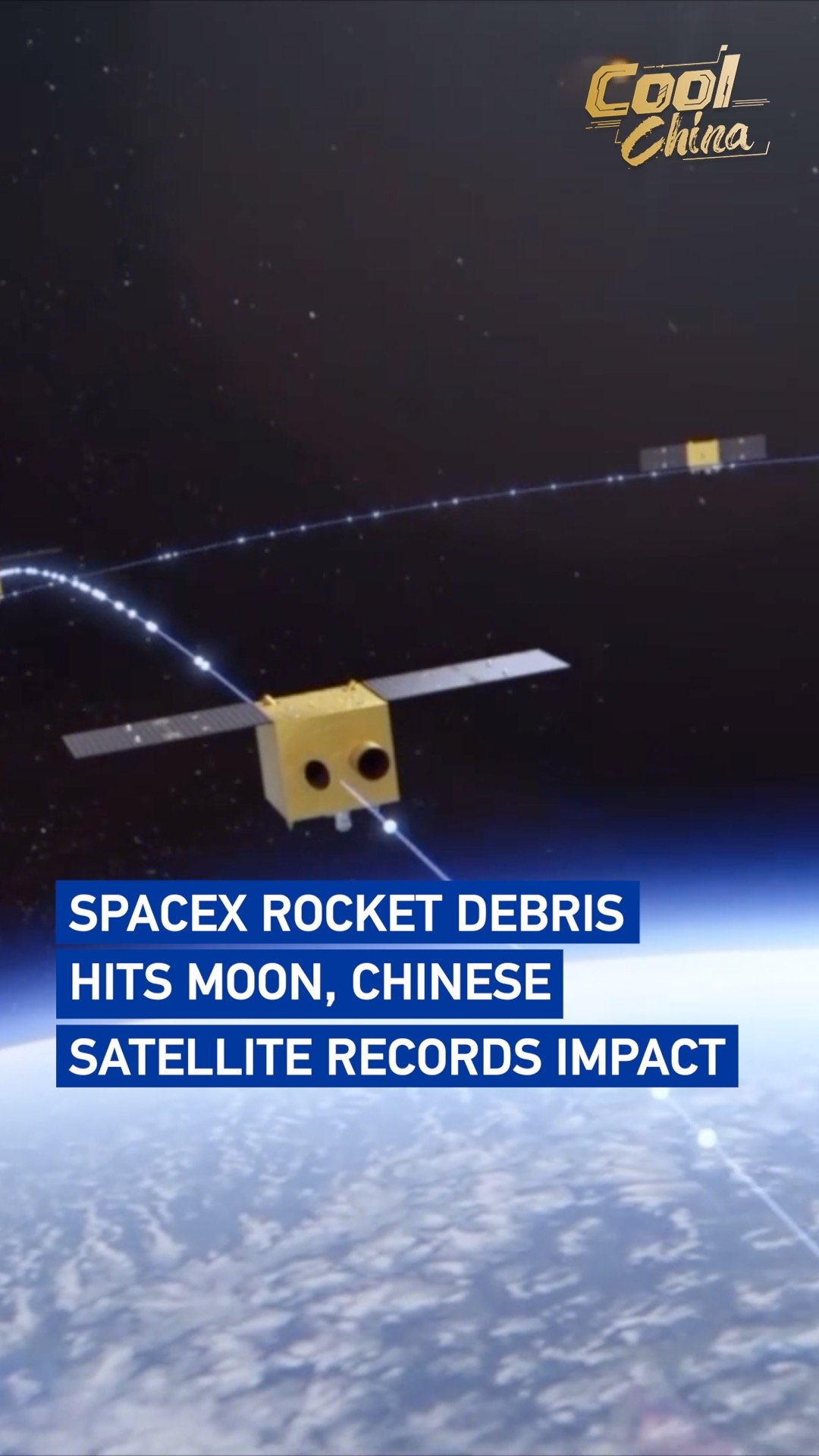
A Chinese lunar satellite has reportedly captured observations linked to the impact of a piece of SpaceX rocket hardware on the Moon, providing scientists with an unusual opportunity to study how human-made objects interact with the lunar surface.
The event involved a rocket remnant that had been left in space after a previous mission. Travelling on a trajectory that eventually brought it into contact with the Moon, the object struck the lunar surface at high speed. Such impacts can create new craters and eject material from beneath the surface, offering researchers valuable information about the Moon’s composition.
China’s lunar spacecraft was able to observe the region associated with the impact, adding an important set of observations to efforts to understand the consequences of uncontrolled objects reaching the lunar surface. Scientists can use images and other measurements from lunar missions to examine changes in the terrain and determine the characteristics of newly formed impact sites.
The incident also highlights the growing amount of human-made material travelling through space around the Moon. As lunar exploration accelerates, more spacecraft, rocket stages and other hardware are being sent into trajectories that can eventually intersect with the lunar surface.
SpaceX rocket remnants have previously attracted attention from astronomers because of their unusual trajectories. Tracking such objects can be challenging because their paths are affected by the gravitational influence of Earth, the Moon and the Sun.
The Chinese satellite’s observations could help researchers establish a clearer picture of the impact and its aftermath. Scientists are particularly interested in determining the size and shape of any crater produced, as well as the amount of lunar material displaced by the collision.
The event has also renewed discussion about space debris and the need for better tracking of objects travelling beyond Earth’s immediate orbital environment. While the Moon has no atmosphere capable of burning up incoming objects, uncontrolled impacts can leave permanent marks on its surface.
With countries and private companies preparing for increasingly frequent lunar missions, experts say monitoring artificial objects around the Moon will become more important. Better tracking could help future missions avoid unexpected encounters and provide scientists with additional opportunities to study impacts.
The latest observation demonstrates how lunar exploration is evolving from a race between individual missions into a broader scientific effort involving multiple spacecraft and space agencies. As more satellites monitor the Moon, researchers may gain a much clearer understanding of both natural and human-made impacts on its ancient surface.









