
Source money control
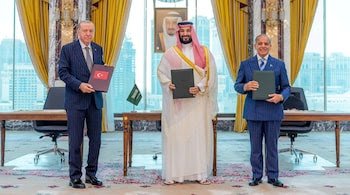
In a move that has drawn global attention, Pakistan, Saudi Arabia, and Turkey are reportedly intensifying their strategic and military cooperation, prompting renewed speculation about the emergence of an “Islamic NATO.” While the term itself remains unofficial and politically sensitive, recent developments suggest a growing alignment among the three nations in defense, security, and geopolitical coordination.
The evolving partnership reflects a convergence of interests among Islamabad, Riyadh, and Ankara, each seeking to strengthen regional influence while addressing shared security concerns. From joint military exercises to defense production agreements, the three countries have steadily expanded their collaboration over the past decade. However, recent high-level meetings and renewed commitments have taken this cooperation to what analysts describe as a “new operational level.”
At the center of this development is the concept often referred to as the “Mecca Pact”—a loosely defined framework of cooperation rooted in shared cultural, religious, and strategic interests. Although not a formal treaty like NATO, the arrangement emphasizes coordination on defense policies, intelligence sharing, and counterterrorism efforts. The latest discussions reportedly include deeper military integration, including joint command structures and coordinated defense planning.
Pakistan has long maintained close defense ties with Saudi Arabia, including training programs and military deployments. The Pakistani military has historically supported Saudi security needs, particularly in safeguarding key installations. Meanwhile, Turkey has emerged as a significant defense partner for both countries, offering advanced military technology, including drones, naval systems, and armored vehicles.
The trilateral cooperation gained momentum through joint military exercises such as “Ataturk” and “Al-Samsam,” which have improved interoperability among their armed forces. Defense industry collaboration is also expanding, with Turkey playing a leading role in technology transfer and co-production initiatives. Pakistan, in turn, provides strategic manpower and operational experience, while Saudi Arabia contributes financial resources and regional influence.
Despite these developments, experts caution against equating the alliance with NATO. Unlike the North Atlantic Treaty Organization, which operates under a formal collective defense clause, the emerging partnership lacks a binding agreement that would obligate member states to defend one another in the event of an attack. Instead, it functions more as a strategic alignment rather than a military bloc.
Geopolitically, the strengthening of ties among these nations is seen as a response to shifting global power dynamics. The Middle East and South Asia are undergoing significant transformations, with traditional alliances evolving and new partnerships emerging. For Saudi Arabia, diversifying its defense relationships beyond Western allies aligns with its broader Vision 2030 strategy. Turkey, under its assertive foreign policy approach, seeks to expand its influence across Muslim-majority regions. Pakistan, facing its own security and economic challenges, views the partnership as an opportunity to bolster its strategic position.
However, the idea of an “Islamic NATO” remains controversial. Critics argue that such terminology risks oversimplifying complex geopolitical relationships and could exacerbate regional tensions. Some countries in the Muslim world have shown reluctance to join any bloc that might be perceived as exclusionary or politically driven. Additionally, differing national interests among the three countries could limit the depth of their cooperation.
International reactions have been mixed. While some observers view the alliance as a natural progression of existing ties, others express concern about its potential implications for regional stability. The United States and European nations are closely monitoring these developments, particularly in light of Turkey’s already complex relationship with NATO and Saudi Arabia’s shifting strategic priorities.
Ultimately, whether this partnership evolves into a formal military alliance or remains a flexible strategic arrangement will depend on future political decisions and regional dynamics. For now, the enhanced cooperation among Pakistan, Saudi Arabia, and Turkey signals a notable shift in the geopolitical landscape—one that could reshape defense partnerships across the Muslim world.
As discussions continue and new agreements take shape, the question remains: is this the beginning of a structured military bloc, or simply a pragmatic alignment of three nations navigating an increasingly multipolar world? The answer may define the trajectory of regional security in the years to come.









