
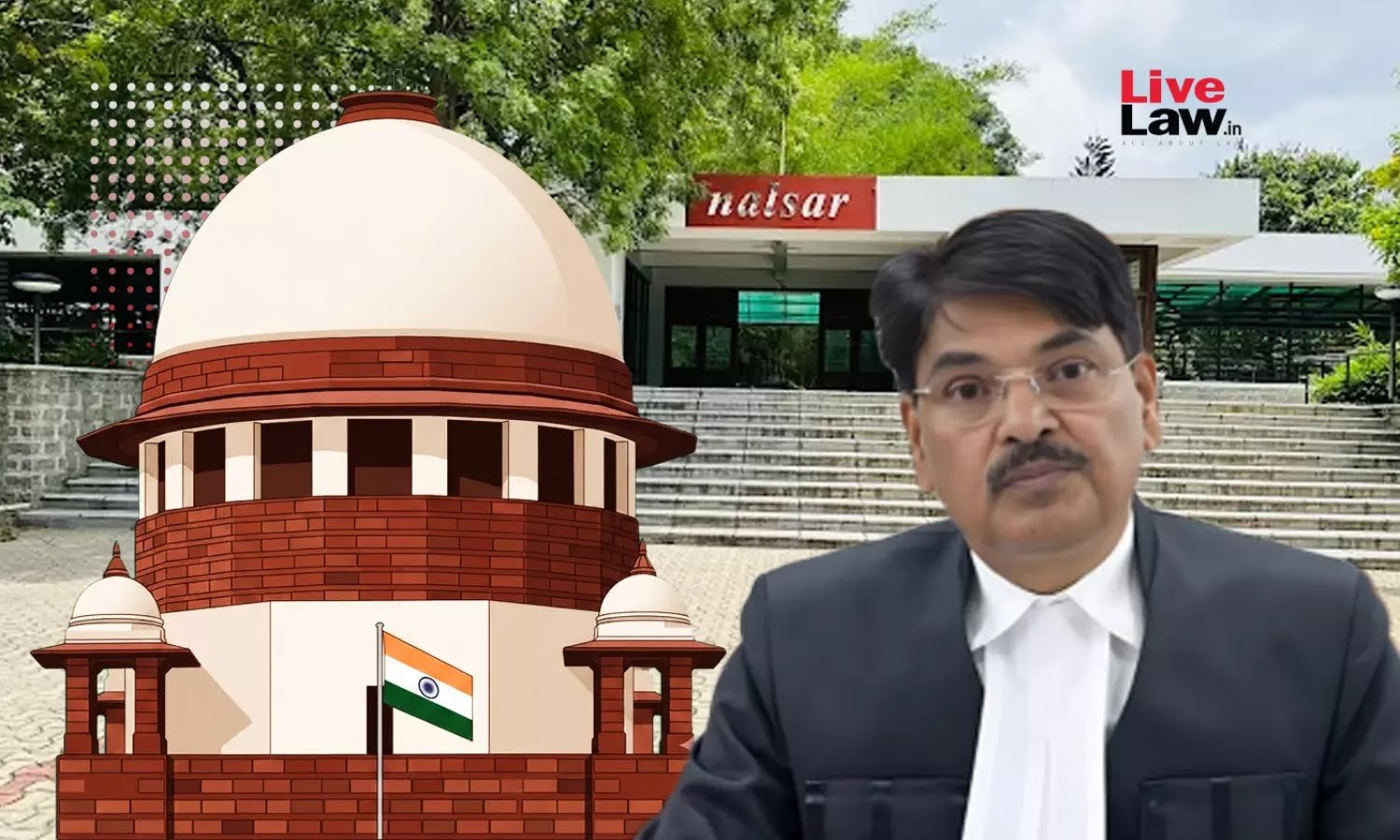
Source Live law
NEW DELHI — The Supreme Court has issued a notice to the Bar Council of India (BCI) following a petition that sought an inquiry into how BCI Chairman Manan Kumar Mishra issued directives targeting students of the NALSAR University of Law. The controversy erupted after a student campaign opposed the invitation of Chief Justice of India (CJI) Surya Kant to the university’s upcoming convocation.
Hearing the plea filed by two NALSAR alumni, a bench comprising CJI Surya Kant, Justice Joymalya Bagchi, and Justice V. Mohana explicitly directed that no punitive action be taken against the university’s students or faculty by any Bar Council.
“A Dialogue Between Me and the Students”
During the hearing, CJI Surya Kant strongly disapproved of the BCI’s involvement in the matter, defending the students’ democratic right to protest.
“BCI has nothing to do with this. We are with you. Students have written a letter to me. It’s a dialogue between students and me,” the CJI remarked, questioning the BCI’s authority to issue such a circular. Recalling his own days of student activism, the Chief Justice added, “Even if they are saying the wrong thing, if they are lawfully raising a voice, it must be allowed”.
The CJI further encouraged the students to swiftly complete their enrollment process and join the Supreme Court Bar, adding that the court could empanel them for legal aid cases as a “befitting answer” to anyone impeding their careers.
Background of the Controversy
The dispute began when NALSAR students circulated a representation concerning the university’s decision to invite the CJI to their convocation. In swift retaliation, BCI Chairman Manan Kumar Mishra issued a directive demanding that the university’s Vice-Chancellor submit a report identifying the organizers and signatories of the campaign. Unprecedentedly, the initial BCI letter also instructed all State Bar Councils to halt the enrollment of NALSAR’s entire 2026 graduating batch.
Following intense backlash from the legal fraternity, the BCI withdrew the enrollment ban within hours, acknowledging that the vast majority of students were innocent. Later, the BCI chairman entirely dropped the proceedings against the students, confirming no further action or inquiry would take place.
The Alumni’s Petition
Despite the withdrawal of the circulars, Senior Advocate K. Parameshwar, representing the petitioners, argued that the core issue regarding the BCI’s overreach still survives.
The petition, filed by NALSAR alumni Mihira Sood and Abhishek Tiwari, argued that the Bar Council of India acted beyond its statutory powers under the Advocates Act, 1961. The plea emphasized that the BCI attempted to manufacture an “extra-statutory disqualification” by penalizing students for participating in a university-level campaign, an action not listed as grounds for disqualification under Section 24A of the Act. The petitioners further noted that such directives create a “chilling effect” on free speech and lawful dissent on university campuses.
The Supreme Court has given the BCI two weeks to file its counter-affidavit regarding the matter.









