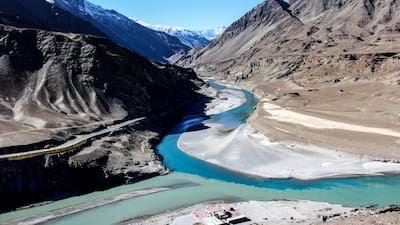
Source NDTV World
India has firmly rejected a recent ruling by a tribunal based in The Hague regarding the Indus Waters Treaty, asserting that the court lacks jurisdiction over the matter. The decision marks a significant development in the long-standing water-sharing dispute between India and Pakistan, which has been governed by the 1960 Indus Waters Treaty brokered by the World Bank.
In an official statement, the Government of India emphasized that it does not recognize the authority of the Hague-based arbitration body in this context. Officials stated that the proceedings initiated by Pakistan were “illegitimate” and violated the agreed dispute resolution mechanisms outlined in the treaty itself. According to India, the treaty provides a clear framework for addressing disagreements, which does not include unilateral recourse to such international arbitration without mutual consent.
The tribunal’s ruling reportedly addressed concerns raised by Pakistan regarding India’s hydroelectric projects on the western rivers allocated to Pakistan under the treaty. Pakistan has long argued that certain Indian projects could affect the flow of water, thereby impacting its agriculture and water security. India, however, maintains that all its projects are fully compliant with the treaty’s provisions and do not alter the natural flow of rivers in any significant way.
Indian authorities reiterated that they remain committed to the Indus Waters Treaty, describing it as a “successful example of cooperation” that has withstood decades of political tensions between the two countries. However, they also stressed that any dispute must be handled strictly within the framework mutually agreed upon in the treaty.
Experts believe that India’s rejection of the tribunal’s ruling could further strain diplomatic relations between the two neighbors, particularly at a time when bilateral ties are already fragile. Some analysts suggest that the dispute highlights the growing challenges in managing shared water resources in South Asia, especially amid climate change and increasing demand.
Pakistan, on the other hand, has welcomed the tribunal’s decision and urged India to comply with the ruling. Pakistani officials have indicated that they will continue to pursue all available legal avenues to safeguard their water rights under the treaty.
The Indus Waters Treaty, signed in 1960, allocates the three eastern rivers—Ravi, Beas, and Sutlej—to India, while the three western rivers—Indus, Jhelum, and Chenab—are reserved primarily for Pakistan, with limited usage rights granted to India. Despite several conflicts between the two nations, the treaty has largely remained intact and is often cited as one of the most resilient water-sharing agreements in the world.
As tensions over the tribunal’s decision continue to unfold, observers are closely watching whether both countries will seek diplomatic engagement or escalate the dispute further. The situation underscores the delicate balance between legal interpretation, national sovereignty, and regional cooperation in managing vital natural resources.