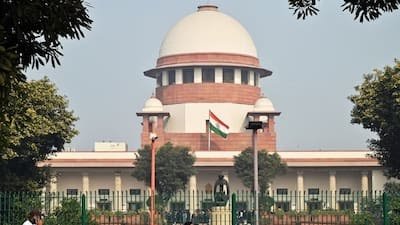
Source NDTV
NEW DELHI — In a stern observation addressing the decades-old linguistic impasse, the Supreme Court of India urged the Tamil Nadu government to abandon reflexive resistance to Union government initiatives and reconsider its rigid opposition to Hindi. The apex court remarked that the state needed to embrace “cooperative federalism rather than confrontation,” underscoring that learning Hindi cannot remain an absolute taboo within the state.
The remarks came from a bench comprising Justice B.V. Nagarathna while hearing a plea challenging a Madras High Court directive that ordered the establishment of Jawahar Navodaya Vidyalayas (JNVs) across every district in Tamil Nadu. Tamil Nadu remains the sole state in the country without a single operational Navodaya Vidyalaya, owing to persistent apprehensions that the institutions’ curriculum serves as a vehicle for Hindi imposition.
Addressing the state’s objections, the bench stressed that regional educational autonomy should not become a barrier to central educational infrastructure that benefits underprivileged students.
“You may have your own education system, but do not prevent Central government schools,” the bench observed. “Don’t have this attitude that ‘it is the Union government, so why should we accept it?’ It cannot be that Hindi will not be taught on the soil of Tamil Nadu. The state needs to change its mindset.”
The top court clarified that the National Education Policy (NEP) and the three-language framework do not mandate Hindi to the exclusion of other choices. Under the policy, schools are required to teach the regional state language, English, and a third Indian language.
“The policy does not say Hindi is compulsory,” the bench pointed out, asking the state counsel why an alternative third language—such as Sanskrit or another modern Indian language—could not be accommodated if the objection was specifically to Hindi.
Tamil Nadu has adhered strictly to a statutory two-language policy (Tamil and English) since 1968, following historic anti-Hindi agitations. The state maintains that a compulsory third language burdens students unnecessarily and erodes state cultural autonomy.
The court emphasized that discussions between the Union government and the state must proceed in an atmosphere of mutual cooperation, reminding authorities that linguistic political disputes should not deprive rural students of quality, fully subsidized residential schooling.
For a detailed broadcast report covering the courtroom exchanges and the court’s observations on the three-language policy, watch the News18 report on the Supreme Court’s language policy remarks. This video provides primary broadcast coverage and legal analysis of the bench’s remarks regarding Hindi imposition claims and school education frameworks.