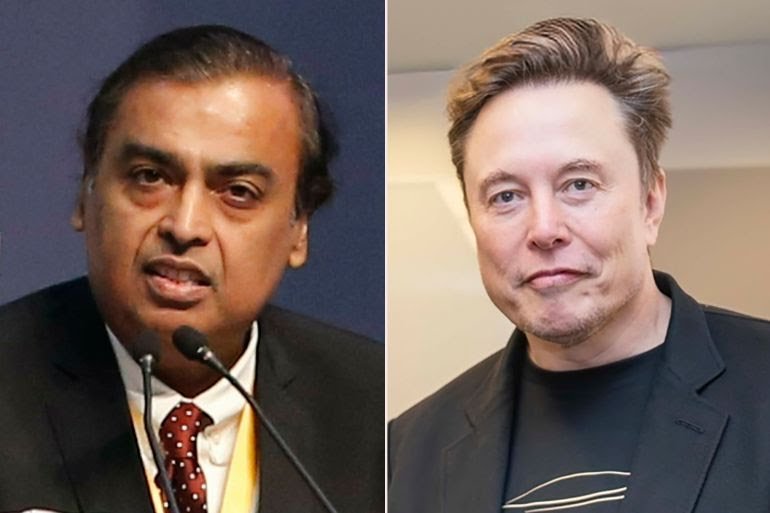
Source Aljajeera
Elon Musk has renewed his push to bring affordable satellite internet to India as competition over the country’s fast-growing internet market continues to attract attention. The billionaire entrepreneur’s plans for Starlink have added another layer to the growing rivalry with Reliance Industries chairman Mukesh Ambani, whose company is a major player in India’s telecom sector.
Starlink, a satellite internet service operated by Musk’s SpaceX, aims to provide internet access through satellites instead of relying only on traditional mobile towers and underground cables. Its expansion into India could create new opportunities for people living in remote areas, while also increasing competition among internet service providers.
Musk Focuses on Affordable Internet
Musk has indicated that Starlink aims to make its services affordable for Indian customers. The promise is important in a country where millions of people depend on low-cost mobile and broadband plans to stay connected.
Starlink’s satellite technology could help connect villages, remote communities and locations where traditional internet services are limited or unreliable. It could also support businesses, schools and healthcare centres that need a stable internet connection.
However, the actual cost of Starlink services in India will be a key factor in deciding how many people can use them. Customers will need to consider not only monthly subscription fees but also the cost of the equipment required to receive satellite signals.
For Starlink to reach a large number of Indian users, its prices will need to compete with the affordable internet plans already offered by established telecom companies.
Why Ambani Is a Major Competitor
Mukesh Ambani’s Reliance Jio has changed India’s telecom market by making mobile data widely available at relatively low prices. Its large customer base and strong network give it a major advantage in the competition for internet users.
Jio has also invested in expanding its 5G services and home broadband business. This puts the company in a strong position as demand for faster and more reliable internet continues to grow.
Starlink follows a different approach. Instead of depending mainly on ground-based networks, it uses satellites to deliver internet services. This could give it an advantage in areas where building traditional networks is difficult or expensive.
The two companies may therefore compete in some areas while serving different needs in others. Starlink could be especially useful in remote locations, while Jio’s existing networks are well suited to serving large numbers of customers in cities and towns.
India’s Satellite Internet Market
India represents a major opportunity for satellite internet companies because of its large population and growing need for digital services. Reliable internet access is increasingly important for online education, digital payments, remote work and business activities.
Yet entering the Indian market requires more than offering advanced technology. Companies must meet government rules, obtain the required approvals and address concerns about security, pricing and network access.
Starlink’s success will depend on how quickly it can meet these requirements and introduce a service that ordinary Indian households can afford.
The government will also have an important role in shaping the market through its decisions on satellite spectrum, licences and other rules governing internet services.
What It Means for Indian Consumers
Growing competition could eventually benefit consumers if companies respond by improving services and offering better value for money. Satellite internet may also help bring connectivity to places that have long struggled with poor network coverage.
However, Starlink’s promise of affordable service will need to be measured against its final prices and the quality of its connection. Indian consumers are highly sensitive to costs, making affordability a central issue.
For now, the growing attention around Musk and Ambani highlights how important India’s internet market has become. If Starlink successfully enters the market with competitive pricing, it could change the way people in remote areas access the internet.
The bigger question is whether satellite technology can match the affordability and reach of India’s established telecom networks. The answer could shape the next stage of the country’s digital growth.