Source HT
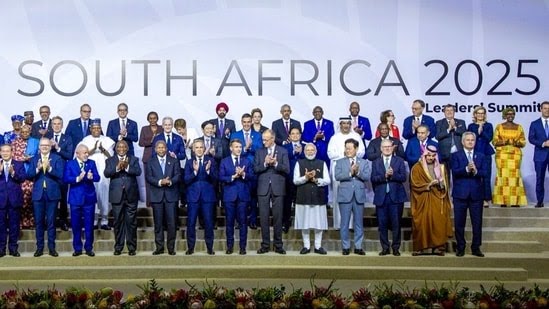
JOHANNESBURG—The recent G20 Leaders’ Summit in Johannesburg, South Africa, concluded with a comprehensive joint declaration, yet was marked by notable diplomatic tension, particularly the United States’ decision to boycott the proceedings. The gathering, the first to be held on the African continent, highlighted a pivotal shift toward addressing the concerns of the Global South and securing global consensus on key development issues.
Here are the five key takeaways that defined the 2025 G20 Summit:
1. 🇮🇳 PM Modi’s Six-Point Agenda for Global Development
Indian Prime Minister Narendra Modi used the summit to propose a sweeping six-point agenda aimed at a “human-centric” approach to global growth and sustainability. Described as India’s contribution to a more secure and sustainable world, the proposals include:
G20-Africa Skills Multiplier Initiative: An ambitious plan to create one million certified trainers in Africa over the next decade through a “train-the-trainer” model, emphasizing Africa’s role in global progress.
G20 Initiative on Countering the Drug–Terror Nexus: A call for a dedicated G20 mechanism to combat the financing of terrorism through an integrated financial, governance, and security approach to curb drug trafficking.
G20 Global Traditional Knowledge Repository: A platform to document and share indigenous wisdom for sustainable living and cultural preservation.
G20 Global Healthcare Response Team: A proposed multinational team of medical experts ready for rapid deployment during health emergencies and natural disasters.
G20 Critical Minerals Circularity Initiative: Focused on enhancing clean energy transitions by promoting recycling, urban mining, and second-life battery innovations to secure supply chains.
G20 Open Satellite Data Partnership: An initiative to make satellite data from member nations more accessible to developing countries for disaster response, agriculture, and climate monitoring.
2. 🤝 Climate Declaration Adopted Despite US Opposition
In a significant diplomatic move, the G20 leaders adopted a joint declaration that included a strong consensus on the severity of climate change and a commitment to scaling up climate finance—despite the formal boycott and objections from the United States delegation.
The final text stressed the urgency of climate action, the need to increase renewable energy targets, and the necessity of enhancing climate finance “from billions to trillions” to meet global needs, particularly for developing nations. The early adoption of the declaration by the other 19 members was seen as a pushback against the US position, underscoring the collective will to advance climate and development goals.
3. 🇺🇸 US Boycott and Diplomatic Fallout
The summit was heavily overshadowed by the absence of the US delegation, ordered by President Donald Trump over a diplomatic spat with host South Africa. This unprecedented boycott meant the US did not participate in the final drafting of the Leaders’ Declaration.
White House officials later criticized the declaration’s language, especially its references to climate change and support for developing countries facing high debt—positions the US administration has long resisted. The boycott and the ensuing diplomatic rift cast a shadow over the symbolic handover of the G20 presidency, which is slated to go to the US for 2026.
4. 🌍 Focus on the Global South and Debt Relief
As the first G20 summit held in Africa, the host nation successfully steered the focus toward the unique challenges faced by the Global South. Key priorities in the final declaration included calls for:
Addressing Sovereign Debt: Heightened concerns about the high debt repayments burdening poorer countries.
Climate Resilience: Support for developing countries grappling with extreme weather and the transition to cleaner energy systems.
Critical Minerals Framework: The introduction of a framework recognizing the strategic importance of critical minerals and ensuring producing countries, especially in the Global South, benefit equitably.
5. 🛡️ Strong Denunciation of Force and Terrorism
The Johannesburg Declaration included a strong collective statement on global security, stressing that “all states must refrain from the threat or use of force to seek territorial acquisition against the territorial integrity and sovereignty or political independence of any state.” This language was interpreted by observers as a broad denunciation of conflicts involving Russia, Israel, and Myanmar. The declaration also carried a firm denunciation of terrorism and called for upholding fundamental freedoms and human rights.
The 2025 G20 Summit underscored a shift in global priorities, demonstrating the grouping’s ability to achieve consensus on critical issues like climate and development even in the face of major diplomatic opposition.