
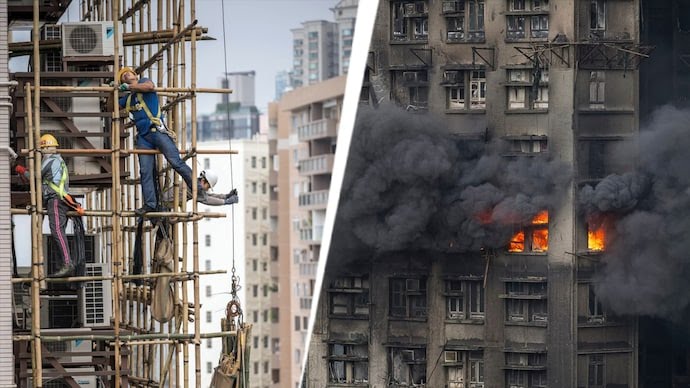
Source India Today
HONG KONG — A devastating high-rise fire in Hong Kong’s Tai Po district, which has claimed dozens of lives and left hundreds missing, has ignited a fierce debate over the city’s construction safety standards, with early investigations pointing to a lethal combination of flammable materials: traditional bamboo scaffolding and substandard construction netting and foam boards.
The inferno, one of the deadliest in Hong Kong in decades, ripped through the exterior of the Wang Fuk Court housing estate, which was wrapped in scaffolding for renovation work. The fire spread with unusual and terrifying speed, engulfing multiple towers in a matter of hours.
The Lethal Factors Under Investigation
While the initial ignition source remains unclear, fire and police officials are focusing their investigation on the materials that fueled the blaze’s rapid vertical and horizontal spread.
Bamboo Scaffolding as a Fuel Ladder: The centuries-old use of bamboo for scaffolding—valued for its low cost, flexibility, and quick erection—is now under intense scrutiny. Experts suggest that the dry, vertical bamboo poles acted as an effective “fuel ladder,” allowing the flames to race up the high-rises and compromise fire compartmentation between floors.
Highly Flammable Construction Nets and Foam Boards: The bamboo structures were draped in plastic green construction netting, often referred to as “cheap Chinese nets” in public discussion, and police have cited the use of highly flammable polystyrene foam boards blocking apartment windows. Authorities suspect that these protective layers and materials failed to meet fire-retardant standards and were key to the fire’s violent and rapid spread.
The combination of the combustible bamboo framework and the potentially substandard netting and foam created an external path that quickly transferred the blaze from the scaffolding into the residential units and to adjacent buildings.
Arrests and Calls for Reform
Police have arrested three individuals—reportedly two company directors and an engineering consultant from the construction firm—on suspicion of manslaughter, citing “gross negligence” and the use of substandard materials.
The tragedy has amplified calls from experts and safety advocates to phase out bamboo scaffolding in favor of non-combustible alternatives, particularly on tall, occupied residential buildings. While the Hong Kong government had previously announced a plan to phase out bamboo scaffolding in public works primarily due to worker safety concerns, this fire has shifted the focus squarely onto its severe fire risk.
“The lesson is not just about the bamboo itself, but the context,” stated a fire safety engineering lecturer, noting that when coupled with highly flammable exterior wraps, the traditional material becomes a severe liability on high-density high-rises.
As search and rescue operations continue, this tragic event is forcing Hong Kong to confront the perilous balance between its construction traditions and modern fire safety imperatives.









