
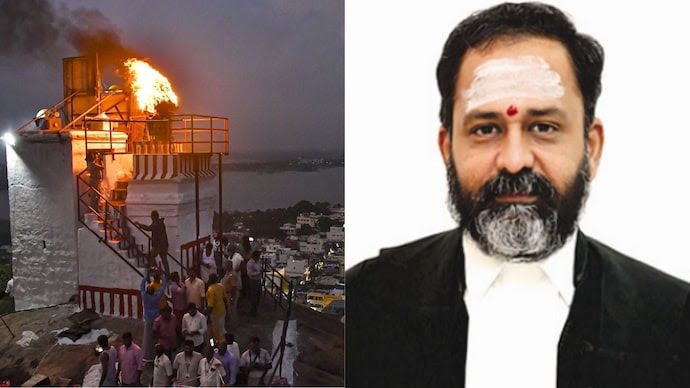
Source India Today
Chennai, December 8, 2025 — Lawmakers from the ruling Dravida Munnetra Kazhagam (DMK) are preparing to move an impeachment motion against GR Swaminathan, a judge at the Madurai Bench of the Madras High Court, following his controversial ruling directing that the traditional “Karthigai Deepam” lamp be lit on a historic stone pillar on a hill — a decision that has ignited religious and political tensions in Tamil Nadu.
The Order and the Controversy
On December 1, Justice Swaminathan allowed writ petitions seeking permission for lighting the Deepam at the “Deepathoon” — an ancient stone pillar located on the hill of the Thiruparankundram temple in Madurai district. He held that the pillar belongs to the temple’s property and that lighting the lamp there would not infringe on the rights of a nearby dargah or the Muslim community.
A Division Bench of the Madras High Court later upheld the ruling, rejecting an appeal against it, and observed that state authorities had “wilfully decided” not to comply initially.
Government Defies the Order, Fears of Communal Tension
Despite the court’s directive, the government of Tamil Nadu declined to implement the order, citing law and order concerns. On the night of the festival, police blocked access to the hilltop, preventing the lamp from being lit at the Deepathoon. Instead, the Deepam was lit at the traditional location at the foot of the hill near the Uchi Pillayar temple. This triggered clashes between right-wing Hindu groups and police.
Authorities had even issued prohibitory orders under Section 144 of the CrPC (equivalent under BNSS in Tamil Nadu) to prevent mass mobilization — a move seen by critics as an attempt to defy the court’s order.
Why DMK Seeks Impeachment
According to party insiders and media reports, the DMK views the judge’s order as reckless and politically motivated, with the potential to inflame communal tensions just months ahead of the Assembly elections.
Party leaders argue that the decision reverses a previous 2017 ruling by a Division Bench of the court — a move they claim undermines judicial consistency and threatens religious harmony in the region.
With sources indicating that DMK MPs will formally submit the impeachment notice, the matter marks an unprecedented challenge to judicial authority, and raises fundamental questions about the separation of powers — between judiciary, executive, and the religious-cultural sensibilities of communities.
Wider Fallout: Politics, Religion and Judiciary in Collision
The lamp-lighting row has already caused upheaval beyond the temple hill. The issue sparked heated debates in Parliament, with opposition and ruling-party MPs clashing over who bears responsibility for communal harmony and constitutional propriety.
Religious and community organizations have also weighed in. Some warn that forcing a ritual at a contested site — especially near a dargah — could disrupt decades-old traditions of coexistence and trigger communal discord.
Meanwhile, state officials have defended their refusal — claiming it was necessary to safeguard peace and maintain stability at a volatile moment.
What Happens Next
Following the failed compliance and the court’s reiteration of its order, the state government has filed a Special Leave Petition (SLP) before the Supreme Court of India. The apex court has agreed to hear the challenge but has not yet set a date.
At the same time, if the impeachment motion gains the necessary support, it could set a precedent — potentially signaling increased legislative scrutiny of judicial decisions on sensitive cultural and religious issues.









