Source Live law
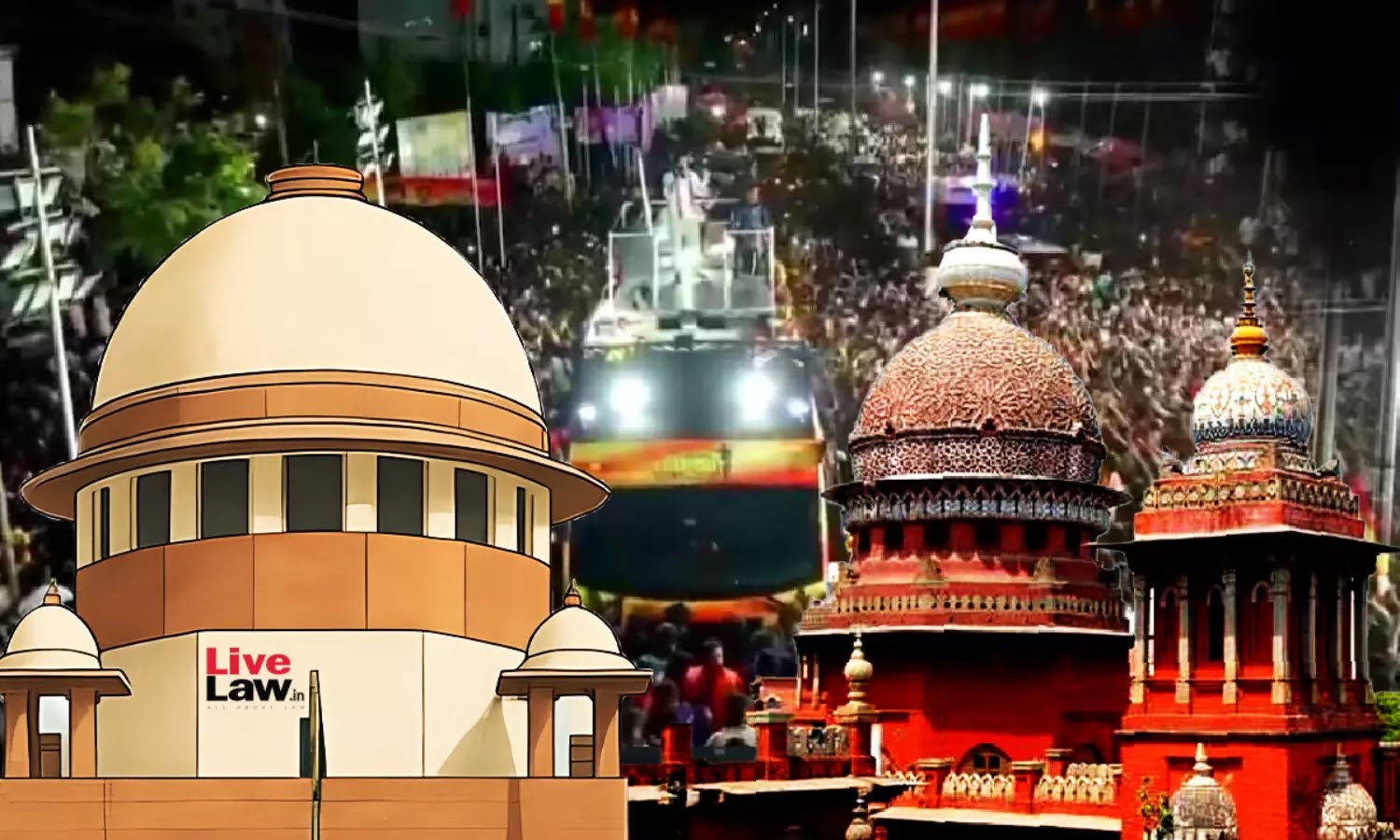
New Delhi, December 12, 2025 — The Supreme Court of India on Friday expressed serious concerns about procedural irregularities in the functioning of the Madras High Court while hearing matters related to the Karur stampede tragedy, remarking that “something wrong” appears to be happening within the High Court’s processes.
A bench of Justices J.K. Maheshwari and Vijay Bishnoi reviewed a detailed report submitted by the Registrar General of the Madras High Court and observed that the manner in which the High Court handled petitions concerning the incident raised significant questions about adherence to correct judicial procedure.
Supreme Court Questions High Court Actions
The scrutiny stems from conflicting High Court orders on how to investigate the tragic stampede that occurred during a political rally in Karur, Tamil Nadu on September 27, which left at least 41 people dead and over sixty injured.
The top court had previously taken exception to how different benches of the Madras High Court addressed related legal petitions. It questioned why the principal seat in Chennai directed the formation of a Special Investigation Team (SIT) comprising only state police officers when the incident fell under the jurisdiction of the Madurai Bench.
The Supreme Court had also noted that the writ petition before the Chennai bench was seeking only standard operating procedures (SOPs) for political rallies and not an SIT probe, raising doubts about the bench’s jurisdiction and decision-making process.
Registrar General’s Report and Court’s Response
After perusing the Registrar General’s report, Justice Maheshwari remarked, “There is something wrong going in the High Court. This is not appropriate…” and directed that the report be circulated among all parties so they could file their responses.
Senior advocate P. Wilson, representing the State of Tamil Nadu, defended the High Court’s approach, stating that orders incidental to a matter were often passed by the bench. Justice Maheshwari, however, indicated that procedural norms must be upheld and suggested that improper practices must be addressed.
CBI Probe and Supervisory Committee
In an interim order on October 13, the Supreme Court ordered a CBI investigation into the Karur stampede, noting the need for an impartial inquiry into the disaster that had “shaken the national conscience.” It also constituted a three-member Supervisory Committee headed by former Supreme Court judge Justice Ajay Rastogi to monitor the investigation, directing that two senior IPS officers on the committee should preferably be from the Tamil Nadu cadre but not natives of the state.
On Friday, the Supreme Court refused to modify this direction, rejecting a request to alter the wording regarding the nationality criteria for committee members.
Next Steps and Notices
The bench has issued notices on a fresh petition filed by one K.K. Ramesh in connection with the case and has asked the parties to complete their pleadings. Meanwhile, the court has yet to finalize how it will proceed with examining the Registrar General’s report on the High Court’s conduct.
Background: The Karur stampede occurred during a rally organised by the Tamilaga Vettri Kazhagam (TVK), a political outfit led by actor-politician Vijay. The tragedy sparked widespread demands for an independent investigation and highlighted concerns about crowd management at large political events.