
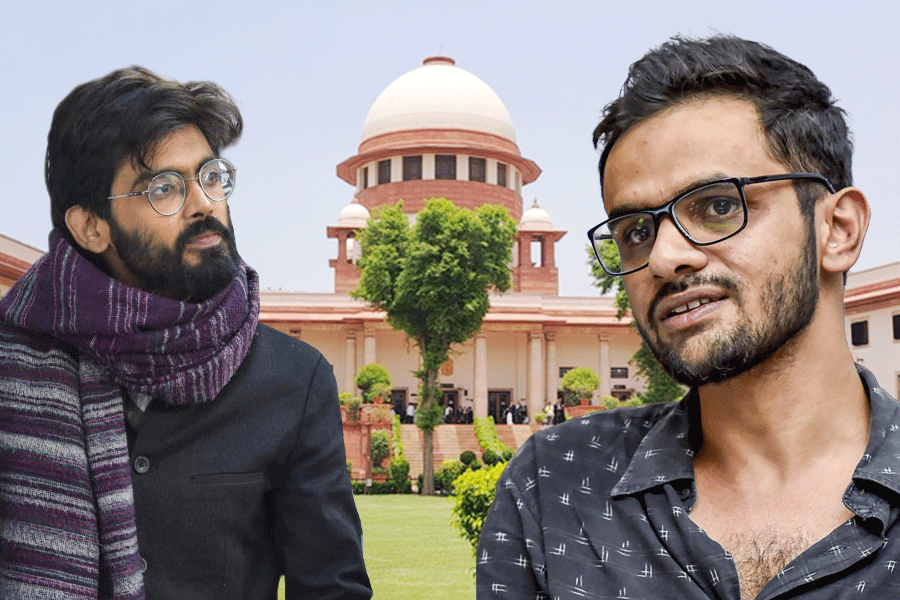
Source telegraph India
NEW DELHI – A fresh wave of controversy hit Jawaharlal Nehru University (JNU) on Monday night as a group of students staged a protest and allegedly raised provocative slogans against Prime Minister Narendra Modi and Union Home Minister Amit Shah. The demonstration followed the Supreme Court’s decision earlier that day to deny bail to former student leader Umar Khalid and activist Sharjeel Imam in the 2020 Delhi riots conspiracy case.
The Protest and Slogans
The protest, held on the evening of January 5, 2026, was organized by a section of the student body to mark the sixth anniversary of the 2020 JNU campus violence. However, the mood of the gathering shifted significantly following the judicial verdict from the apex court.
According to purported videos circulating on social media, students were seen chanting slogans directed at the country’s top leadership. The university administration has since written to the Delhi Police, describing the slogans as “highly objectionable, provocative, and inflammatory.”
“The raising of such slogans is wholly inconsistent with democratic dissent and has the potential to seriously disrupt public order and campus harmony,” the JNU Chief Security Officer stated in a formal letter seeking an FIR.
JNUSU’s Stance
Jawaharlal Nehru University Students’ Union (JNUSU) President Aditi Mishra defended the students, clarifying that the protest is an annual event to remember the “January 5 mob attack” on the campus. Regarding the slogans, Mishra told reporters that they were “ideological in nature” and not intended as personal attacks. She argued that the students were expressing their resentment toward what they perceive as a “miscarriage of justice.”
The Supreme Court Verdict
The protests were triggered by the Supreme Court bench of Justices Aravind Kumar and NV Anjaria, which ruled that Umar Khalid and Sharjeel Imam played an “architectural” and “central” role in the alleged larger conspiracy behind the February 2020 Northeast Delhi riots.
Bail Denied: The court held that the material against Khalid and Imam was “prima facie true,” invoking the stringent provisions of the Unlawful Activities (Prevention) Act (UAPA).
Relief for Others: While Khalid and Imam were denied relief, the court granted bail to five other co-accused, including Gulfisha Fatima and Meeran Haider, noting that they stood on a “qualitatively different footing.”
Future Recourse: The court gave Khalid and Imam the liberty to apply for bail again after one year or once the examination of protected witnesses is complete.
Political and Legal Reaction
The incident has sparked a sharp political divide:
BJP: Leaders condemned the slogans, calling the protesters “enemies of the country” and alleging that the opposition parties are backing “separatist elements.”
Opposition: Members of the Congress and CPI(M) questioned the continued detention of Khalid and Imam without trial for over five years, contrasting it with the frequent paroles granted to other high-profile convicts.
The JNU administration has announced an internal inquiry to identify the students involved in the sloganeering and has promised “corrective action.”









