Source India Today
NUUK, GREENLAND — As geopolitical tensions over the Arctic reach a boiling point, the Danish government has issued a stark reminder to Washington: any uninvited military entry into Greenland will be met with immediate force.
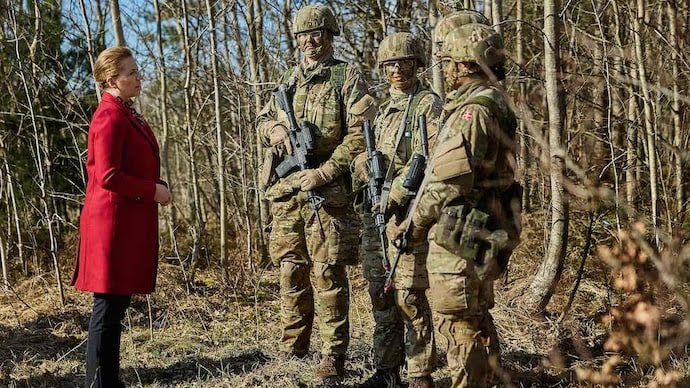
Citing a Cold War-era directive from 1952, the Danish Ministry of Defence confirmed this week that troops stationed in the territory are under standing orders to “shoot first and ask questions later.” The directive mandates that Danish forces “immediately take up the fight” against an invading force without waiting for political clearance from Copenhagen—a policy intended to prevent a decapitation strike from paralyzing the island’s defense.
The announcement comes in response to increasingly aggressive rhetoric from the Trump administration, which has suggested that the U.S. might seek “jurisdiction” over the mineral-rich island by force, citing national security concerns and the “failure” of Denmark to properly secure the Arctic.
The “David vs. Goliath” Defense
While the rhetoric is fiery, military analysts are quick to point out the staggering asymmetry between the two NATO allies. If the U.S. were to move on Greenland, what exactly would Denmark use to stop them?
The Danish presence in Greenland is overseen by the Joint Arctic Command (JACO). While Denmark is currently in the midst of a $13.8 billion (DKK 95 billion) defense buildup, many of those assets are not yet fully operational.
Capability Current Assets & Plans (2026)
Maritime 5 Arctic-class vessels with icebreaking capability; 3 frigates occasionally on rotation.
Air Power A planned fleet of 43 F-35A Lightning II jets (16 recently ordered), supported by “loyal wingman” drones.
Ground Forces The elite Sirius Dog Sled Patrol (special forces), a new specialized Arctic unit in Nuuk, and the emerging “Greenlandic Rangers.”
Surveillance P-8 Poseidon maritime patrol aircraft and a new early-warning radar system in East Greenland.
A Symbolic Tripwire
Military experts argue that Denmark’s “shoot first” policy is less about winning a conventional war and more about creating a political tripwire.
“Denmark cannot defeat a U.S. carrier strike group or an airborne division,” says Arctic security analyst Jacob Kirkegaard. “But by engaging immediately, they ensure that any U.S. move is legally and diplomatically framed as an act of war against a sovereign NATO ally.”
Danish Prime Minister Mette Frederiksen echoed this sentiment, warning that a military move by the U.S. would effectively “end NATO.” Under Article 5 of the North Atlantic Treaty, an attack on one member is an attack on all. If the U.S. were the aggressor, the treaty—and the post-WWII security architecture—would likely collapse instantly.
The View from Nuuk
In Greenland’s capital, Nuuk, the mood is a mix of defiance and exhaustion. Prime Minister Jens-Frederik Nielsen has urged Washington to drop its “annexation fantasies,” while also pushing for a faster path to full independence from Denmark.
For now, the thin line of Danish defense—mostly comprised of specialized patrol units and a handful of advanced fighter jets—remains the only physical barrier to a U.S. “takeover.” While they may be outmatched, Copenhagen has made it clear: they will not go quietly.