Source daily galaxy
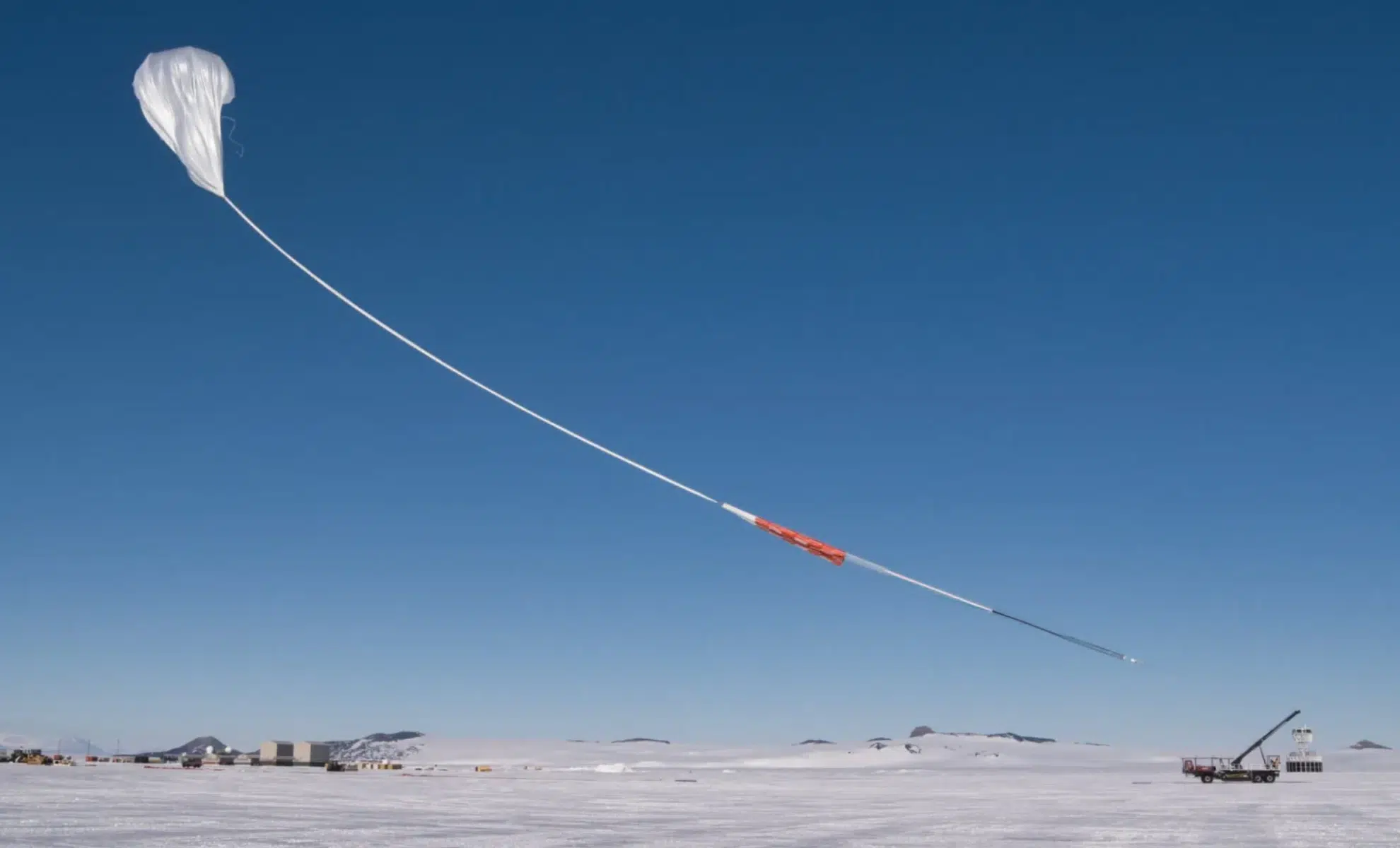
MCMURDO STATION, ANTARCTICA — In a landmark achievement for suborbital astrophysics, NASA’s Scientific Balloon Program has successfully concluded its 2025–2026 Antarctic campaign, providing what researchers describe as a “breakthrough” window into the invisible universe.
The campaign, which featured the simultaneous flight of four balloons over the frozen continent, was headlined by the General Antiparticle Spectrometer (GAPS). This mission specifically sought out rare antimatter particles that may serve as the “smoking gun” for dark matter—the mysterious substance believed to constitute over 80% of the universe’s mass.
High-Altitude Laboratories in the Stratosphere
During the Antarctic summer, unique atmospheric conditions create a circular wind pattern known as the stratospheric vortex. This allows NASA to launch stadium-sized balloons that circle the South Pole for weeks at a time, staying aloft in constant daylight to power their instruments via solar panels.
The Key Missions
The 2025–2026 season saw record-breaking durations and highly sensitive data collection:
GAPS (General Antiparticle Spectrometer): Launched on December 15, 2025, GAPS flew for over 25 days. It was designed to detect low-energy antideuterons and antiprotons. Because these particles are rarely produced by standard cosmic ray interactions, their detection would likely indicate the decay or annihilation of dark matter particles.
PUEO (Payload for Ultrahigh Energy Observations): Launched on December 19, 2025, this mission spent 23 days scanning the Antarctic ice for radio pulses. These pulses are created when ultra-high-energy neutrinos—ghostly particles from the edge of the observable universe—collide with the ice shelf.
Why Antarctica?
Antarctica is the premier location for these “near-space” missions for three primary reasons:
The Polar Vortex: Stable winds keep the balloons over land, making the recovery of expensive hardware and data drives much easier.
Geomagnetic Shielding: Near the poles, Earth’s magnetic field lines dip toward the surface, allowing cosmic particles (like those GAPS is hunting) to penetrate deeper into the atmosphere where balloons can “catch” them.
The Ice: For missions like PUEO, the vast, clear Antarctic ice acts as a giant detection medium, amplifying the tiny radio signals produced by passing neutrinos.
A New Era of “Pioneer” Science
This campaign also marked the debut of the Astrophysics Pioneers program, a NASA initiative intended to produce high-impact science at a fraction of the cost of traditional satellite missions.
“These balloons allow us to do world-class science for millions of dollars rather than billions,” said a NASA spokesperson. “The GAPS mission, in particular, has now provided us with the most sensitive dataset ever recorded in this specific energy range. We are looking at the ‘dark’ side of our galaxy with more clarity than ever before.”
With the payloads now safely recovered from the ice as of mid-January 2026, scientists have begun the arduous task of analyzing terabytes of data. While a definitive “discovery” of a dark matter particle usually takes months of peer review, the team is optimistic that the sheer volume of antimatter signatures captured will redefine our understanding of cosmic evolution.