Source swarajyamag
India’s first solar observatory, Aditya-L1, has provided crucial new insights into how a powerful solar storm in October 2024 dramatically compressed Earth’s magnetic shield, offering scientists a clearer understanding of space weather events that can disrupt modern technology.
According to scientists associated with the Indian Space Research Organisation (ISRO), instruments onboard Aditya-L1 observed an intense burst of charged particles and magnetic energy released from the Sun, known as a coronal mass ejection (CME). As this solar storm traveled through space and struck Earth, it caused a significant compression of the planet’s magnetosphere — the invisible magnetic bubble that protects Earth from harmful solar radiation.
What Aditya-L1 Observed
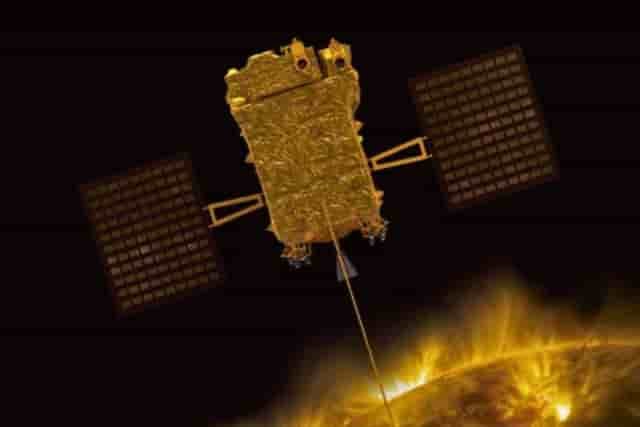
Positioned at the Lagrange Point L1, about 1.5 million kilometres from Earth, Aditya-L1 has a continuous, unobstructed view of the Sun. During the October 2024 event, the spacecraft’s payloads recorded sharp changes in solar wind speed, density, and magnetic field orientation.
Data showed that the incoming solar storm pushed Earth’s magnetopause — the outer boundary of the magnetosphere — much closer to the planet than usual. This compression increased the flow of energetic particles into near-Earth space, triggering geomagnetic disturbances.
Impact on Earth
While the storm did not cause widespread damage, it led to temporary disruptions in satellite communications, minor GPS inaccuracies, and enhanced auroral activity observed at lower-than-usual latitudes. Scientists say such events highlight the vulnerability of space-based and ground-based technological systems to extreme solar activity.
Why This Discovery Matters
ISRO scientists emphasized that Aditya-L1’s observations are vital for improving space weather forecasting. Understanding how solar storms interact with Earth’s magnetic field can help agencies issue early warnings to protect satellites, power grids, aviation systems, and astronauts.
“This is a significant step in linking solar observations directly to their effects near Earth,” an ISRO official said, adding that Aditya-L1’s data will contribute to global efforts to model and predict solar storm impacts more accurately.
India’s Growing Role in Solar Science
Launched in September 2023, Aditya-L1 continues to strengthen India’s position in heliophysics research. The findings from the October 2024 solar storm demonstrate the mission’s capability to deliver high-quality, real-time data crucial for understanding the Sun–Earth connection.
As the Sun approaches the peak of its current solar cycle, scientists expect more such powerful storms in the coming years, making Aditya-L1’s role increasingly important in safeguarding Earth’s technological infrastructure.