
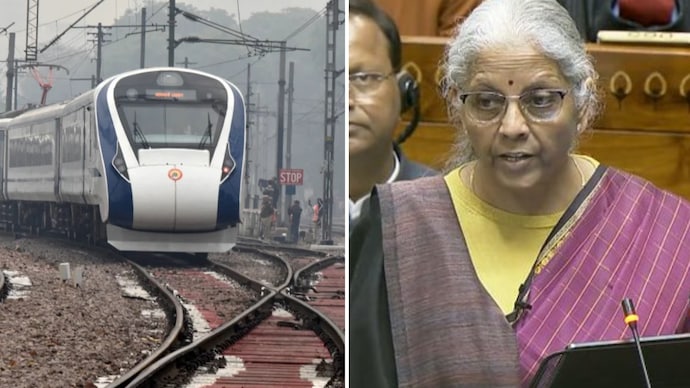
Source India Today
NEW DELHI – In a landmark move for India’s infrastructure, Finance Minister Nirmala Sitharaman announced the development of seven new high-speed rail (HSR) corridors during the presentation of the Union Budget 2026. This ambitious expansion aims to transform the nation’s transport landscape, positioning these corridors as “growth connectors” for major economic and urban hubs.
The announcement signals a massive shift toward high-speed connectivity, particularly in the Southern and Northern regions, with a staggering estimated investment of ₹16 lakh crore for nearly 4,000 km of new tracks.
The New High-Speed Map
The seven newly approved corridors focus on linking India’s busiest industrial and technology clusters. Notably, the plan includes a “Southern Triangle” connecting Bengaluru, Chennai, and Hyderabad.
Corridor Key Cities Linked Estimated Travel Time
Mumbai – Pune Financial Capital to IT/Edu Hub 48 Minutes
Chennai – Bengaluru Auto Hub to Silicon Valley of India 1 Hour 13 Minutes
Pune – Hyderabad Manufacturing to Pharma/IT Hub 1 Hour 55 Minutes
Hyderabad – Bengaluru Major Tech Corridors 2 Hours
Hyderabad – Chennai Port City to Global Business Center 2 Hours 55 Minutes
Delhi – Varanasi Political Capital to Spiritual Center 3 Hours 50 Minutes
Varanasi – Siliguri Spiritual
A Vision for “Viksit Bharat”
The Finance Minister emphasized that these projects are central to the “Viksit Bharat” (Developed India) 2047 vision. Unlike traditional rail upgrades, these corridors will use advanced signaling and international-standard tracks, supporting trains capable of speeds exceeding 250–320 km/h.
“These corridors will connect India’s financial hubs, technology centers, manufacturing clusters, and emerging cities through faster, cleaner mobility,” Sitharaman stated in her Budget speech.
Strategic Infrastructure Push
Massive Outlay: The Indian Railways received its highest-ever capital expenditure allocation of ₹2.93 lakh crore.
Indigenization: While the ongoing Mumbai-Ahmedabad project involves Japanese partnership, the new routes are expected to feature higher levels of “Made in India” technology, potentially utilizing the indigenous Vande Bharat high-speed platform.
Regional Impact: Railway Minister Ashwini Vaishnaw noted that all corridors would be developed simultaneously to ensure balanced regional growth, linking the Indo-Gangetic plains to the industrial belts of the West and South.
The government’s focus on Tier-II and Tier-III cities with populations over five lakh ensures that the economic benefits of high-speed rail trickle down beyond just the mega-metros, fostering a new era of urban and industrial development.









