
Source TOI
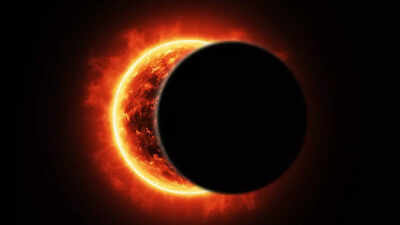
A rare astronomical event will grace the skies on February 17, 2026, as the year’s first annular solar eclipse takes place. Skywatchers across several regions of the world will witness the famous “ring of fire,” a glowing circle of sunlight surrounding the dark silhouette of the Moon.
Why the Moon Won’t Fully Cover the Sun
A solar eclipse happens when the Moon moves between the Sun and the Earth, blocking sunlight partially or completely.
However, not all eclipses are total. In this case, the eclipse will be annular because the Moon will be farther away from Earth in its orbit. When the Moon is at a greater distance, it appears slightly smaller in the sky and cannot cover the Sun entirely. As a result, a bright outer rim of sunlight remains visible.
Astronomers explain that the Moon’s orbit around Earth is elliptical, meaning its distance constantly changes. During this eclipse, the alignment will be precise, but the apparent size difference creates the glowing ring effect instead of complete darkness.
How the “Ring of Fire” Forms
At the peak moment — called maximum eclipse — the center of the Sun will be hidden while its outer edges remain visible. This produces a sharp, luminous circle that looks like a burning halo in the sky. The phenomenon is popularly known as the ring of fire and lasts only a few minutes along the central viewing path.
Unlike a total solar eclipse, the sky will not turn completely dark, and stars will not appear. Daylight will simply dim, giving the surroundings an eerie twilight glow.
Viewing Safety
Scientists strongly warn against looking directly at the Sun without proper protection. Even during an annular eclipse, the Sun’s rays remain intense and can cause permanent eye damage. Certified eclipse glasses or solar filters are necessary to observe the event safely.
Why It Matters
Such eclipses are not only visually spectacular but also scientifically valuable. Researchers study solar radiation changes, atmospheric reactions, and temperature variations during these events. For enthusiasts, it offers a chance to witness one of nature’s most dramatic alignments — a cosmic reminder of the precise mechanics of our solar system.
The February 17 eclipse marks the first solar eclipse of 2026 and promises to captivate millions as the fiery ring briefly lights up the daytime sky.









