Source The eurasian time
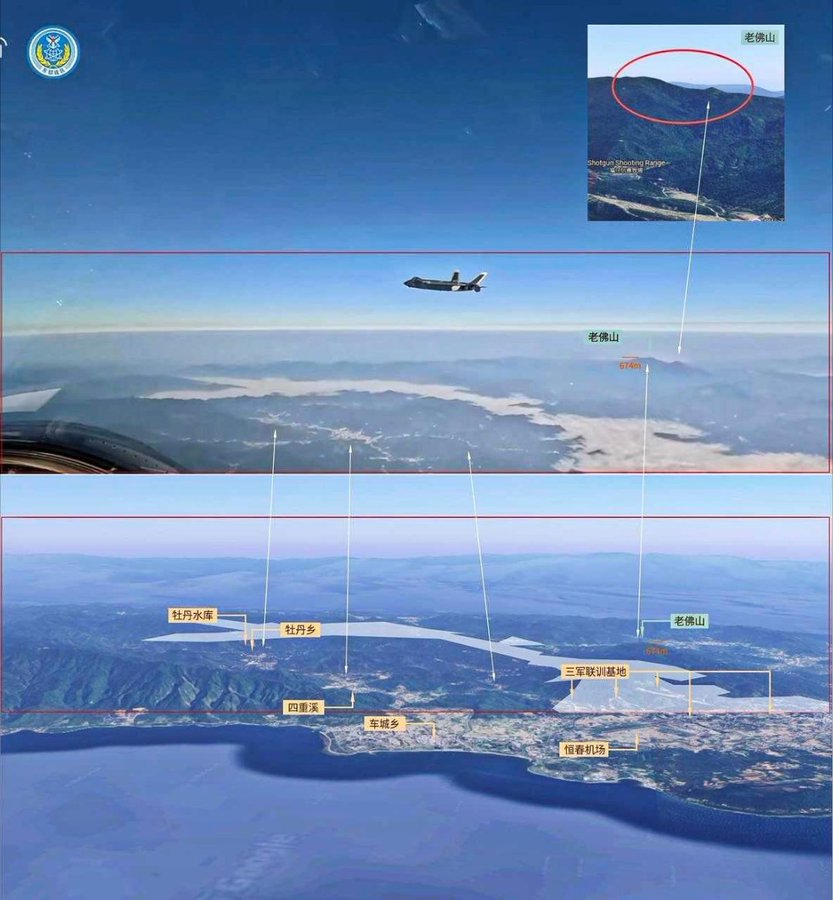
TAIPEI / BEIJING — In a move that has reignited debates over the balance of power in the Taiwan Strait, Chinese state-affiliated media and military channels have claimed that a Chengdu J-20 “Mighty Dragon” stealth fighter successfully conducted a flight within visual range of Taiwan’s coastline without being detected by the island’s defense systems.
The reports, which surfaced in late December 2025 following the massive “Justice Mission 2025” military exercises, suggest a new level of operational confidence for the People’s Liberation Army Air Force (PLAAF). However, defense analysts and Taiwanese officials are questioning whether the claim is a demonstration of genuine stealth prowess or a calculated psychological operation.
The Claim: “I Saw the Mountains of Treasure Island”
The narrative gained momentum after a PLAAF J-20 pilot, Captain Yang Juncheng, spoke to state broadcaster CCTV. Yang claimed he had flown over the “Treasure Island” (a common Chinese term for Taiwan), stating he could see the island’s coastline and mountains clearly from his cockpit.
“There is no such thing as the Taiwan Strait… this line or that line,” Yang reportedly said, referring to the tacitly agreed-upon “median line” that Beijing has increasingly ignored.
Social media accounts linked to the PLA further amplified the story, alleging that J-20s flew within 10 kilometers of the Pingtung airbase in southern Taiwan. They pointed to the lack of an official alert from Taiwan’s Ministry of National Defense (MND)—which usually reports every PLA sortie—as “proof” that the stealth jets went unnoticed.
The Counter-Argument: Information Warfare?
Taipei has remained notably reserved regarding the specific J-20 claims, a posture some experts call “calculated silence” to avoid validating Beijing’s narrative. However, Taiwanese lawmakers and experts have dismissed the footage as potentially misleading.
Scenic Similarities: Lawmaker Wang Ting-yu suggested that the video released by the PLA was likely filmed over Guangdong province, which shares a similar coastal topography with southern Taiwan.
Passive Detection: While the J-20 is designed to evade traditional radar, Taiwan has recently showcased its own “silent” capabilities. Just days ago, the MND released footage from an F-16V’s Sniper Advanced Targeting Pod, showing it tracking a Chinese J-16 fighter without the Chinese pilot’s knowledge. This suggests that even if radar fails, Taiwan’s passive electro-optical systems remain a formidable barrier.
Stealth Prowess vs. Radar Reality
The J-20 is China’s most advanced fifth-generation fighter, featuring radar-absorbent materials and a stealth-optimized airframe. Whether it can truly evade Taiwan’s multi-layered defense network—which includes Patriot missile batteries, homegrown Sky Bow systems, and PAVE PAWS long-range radar—remains a subject of intense scrutiny.
Perspective Key Argument
Beijing’s Stance The J-20 can penetrate any regional airspace undetected, rendering Taiwan’s defenses obsolete.
Western Analysts The J-20 is highly capable but likely “tracked” by allied sensors (including US assets) that simply choose not to reveal their detection capabilities.
Taiwanese Defense Use of “Grey Zone” tactics and propaganda is intended to sap public morale and create a “fait accompli” regarding air superiority.
Strategic Implications
Regardless of whether the J-20 was truly “invisible,” the claim itself serves a strategic purpose. By signaling that their most advanced jets can operate within visual range of Taiwan, Beijing is compressing Taipei’s reaction time and increasing the psychological pressure on its pilots.
As the “Justice Mission 2025” drills conclude, the focus shifts from the hardware in the sky to the battle for the narrative on the ground. For now, the “Mighty Dragon” remains a centerpiece of China’s effort to prove that the Taiwan Strait is no longer a barrier, but a backyard.