
Source The economics Times
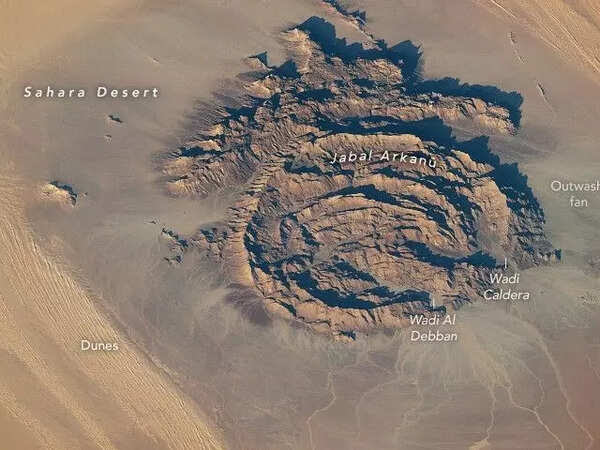
HOUSTON, TEXAS—NASA has captured the imagination of the public and geologists alike by releasing a breathtaking new image of Jabal Arkanu, a rare, ring-shaped geological wonder nestled deep in the Sahara Desert of southeastern Libya. Taken by an astronaut aboard the International Space Station (ISS) on September 13, 2025, the photograph dramatically highlights the mountain’s striking concentric ridges against the pale, sandy plains.
A Geological Enigma from Above
Jabal Arkanu, also known as Jebel Arkenu, is a large, alkaline igneous ring complex that rises sharply, reaching an elevation of approximately 1,400 meters above sea level—800 meters higher than the surrounding desert floor. The mountain massif is about 24 kilometers wide and is located near the Egyptian border.
The high-resolution ISS photograph, captured with an 800mm lens, showcases the near-perfect symmetry of the rings, with long shadows cast across the vast, arid landscape in the late afternoon sun. The view from orbit provides an unparalleled perspective on the sheer scale and complexity of this ancient structure.
Earth’s Forces, Not Cosmic Impact
For years, the distinct circular pattern of Jabal Arkanu, and similar structures nearby, led some scientists to speculate they were ancient meteorite impact craters. However, extensive geological fieldwork has since disproved this theory, confirming the rings have a purely terrestrial origin.
According to researchers, the formation developed over millions of years—dated to around 50 million years ago—from a series of repeated magma intrusions. Molten rock pushed upward from the Earth’s interior, penetrating and uplifting the overlying layers of older rock. As the magma cooled into igneous rocks like basalt and granite, and subsequent erosion by wind and minimal rainfall carved away the softer material, the concentric, overlapping ring structures were exposed. The center of these overlapping rings is slightly tilted toward the southwest.
Hyper-Arid Climate and Enduring Features
The region around Jabal Arkanu is one of the driest places on Earth, receiving only 1–5 millimeters of rain annually, though the mountain itself experiences slightly more due to the orographic effect. Despite the hyper-arid climate, the photograph reveals two dry riverbeds, or wadis, carving through the massif, hinting at the infrequent, but powerful, water flow that has also helped sculpt the formation over millennia.
The stunning image from the ISS not only provides a beautiful vista but also offers geologists a crucial tool for studying how large-scale geological structures persist under extreme climatic stress, serving as a striking visual record of Earth’s dynamic and ancient history.









