
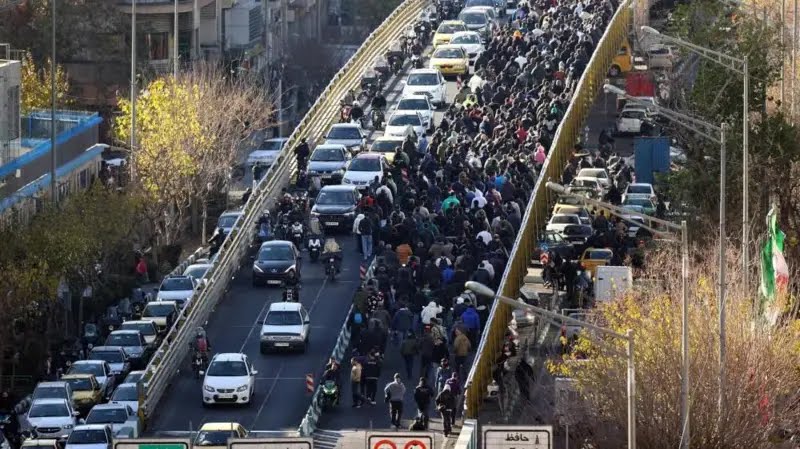
Source bbc
TEHRAN – The most significant wave of unrest in Iran since 2022 has escalated into deadly violence, with the death toll rising to at least 10 people following a week of clashes between security forces and protesters.
What began as a strike by Tehran shopkeepers on December 28, 2025, has rapidly transformed into a nationwide uprising. Driven by a collapsing national currency and skyrocketing inflation, the demonstrations have now spread to over 100 locations across 22 provinces, reaching as far as the clerical stronghold of Qom and the restive southeastern province of Sistan and Baluchistan.
A Spiraling Economic Crisis
The spark for the current unrest is the historic devaluation of the Iranian rial. Following a 12-day conflict with Israel in June 2024—which included U.S. and Israeli strikes on nuclear and military infrastructure—Iran’s economy has remained in a tailspin.
Currency Collapse: The rial has plunged to a record low of approximately 1.4 million to $1 USD.
Inflation: Official figures placed inflation at 42.5% in December, though independent analysts suggest the real-world impact on food and housing is significantly higher.
Widespread Strikes: Bazaar traders and shop owners, traditionally a pillar of the Iranian establishment, have shuttered their businesses in protest, citing an inability to operate under current market fluctuations.
Fatalities and “Battlefield” Conditions
While the Iranian government initially signaled a more conciliatory tone than in previous years, the response has turned increasingly lethal as the protests moved into rural and mid-sized cities.
Reports from state-affiliated media and human rights groups like Hengaw and HRANA indicate that the most severe violence has occurred in the western and southwestern provinces of Lorestan and Chaharmahal and Bakhtiari.
Lordegan & Azna: At least five people were killed in these western cities during what state media described as “attacks on government buildings” and “armed rioting.”
Security Forces: The Revolutionary Guard (IRGC) confirmed the deaths of at least two security personnel, including a member of the Basij paramilitary force who was reportedly stabbed and shot in the city of Harsin.
State Tactics: Authorities have utilized tear gas and, according to various activist videos, live ammunition to disperse crowds. In a departure from previous crackdowns, the government has not yet implemented a total nationwide internet blackout, though localized disruptions have been reported.
Supreme Leader Vows “No Yielding”
In a recorded television appearance on Saturday, January 3, Supreme Leader Ayatollah Ali Khamenei acknowledged the legitimacy of the economic grievances but took a hard line against the unrest.
“The bazaaris were right… they cannot do business in these conditions,” Khamenei stated. “We will speak with the protesters, but talking to rioters is useless. Rioters should be put in their place.”
The rhetoric suggests a “dual-track” strategy: acknowledging the pain of the middle class while delegitimizing the street protests as the work of “foreign-backed disruptors.”
International Reactions
The internal crisis is being closely watched globally. U.S. President Donald Trump warned Tehran on Friday that the United States is “locked and loaded” and ready to “come to the rescue” of peaceful protesters if the Iranian government continues a violent crackdown. These statements have been met with condemnation from Tehran, with officials accusing the U.S. and Israel of inciting regional instability.
As funerals for those killed begin to transform into fresh anti-regime rallies, the situation remains volatile. With the rial showing no signs of recovery, the pressure on President Masoud Pezeshkian’s government to find an economic solution continues to mount.









