
Source money control
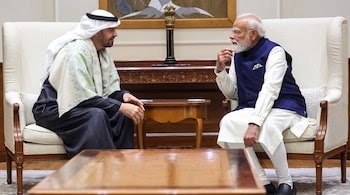
New Delhi: United Arab Emirates President Sheikh Mohamed bin Zayed Al Nahyan (MBZ) made a high-impact, three-hour visit to India, underscoring the deepening strategic partnership between the two countries across defence, nuclear energy and trade. Despite its short duration, the visit sent a strong geopolitical signal in South Asia — one that is being closely watched in Islamabad.
A Strategic Visit with Clear Priorities
MBZ held high-level discussions with Prime Minister Narendra Modi and senior Indian officials, focusing on accelerating cooperation in defence manufacturing, energy security and advanced technology. Sources indicated that both sides reviewed progress under the Comprehensive Economic Partnership Agreement (CEPA) and reaffirmed their ambition to push bilateral trade to $200 billion in the coming years.
The UAE is already among India’s top trading partners, and officials believe the expanded trade target reflects growing confidence in supply chain integration, investments, and joint ventures spanning logistics, infrastructure, fintech and green energy.
Defence and Nuclear Cooperation in Focus
A key element of the talks was defence collaboration, including joint production, technology transfer and maritime security in the Indian Ocean region. India has emerged as a reliable defence manufacturing partner, while the UAE is seeking diversified security partnerships beyond traditional suppliers.
Nuclear energy cooperation also featured prominently, particularly in the context of clean energy transitions and long-term power security. India’s experience in civilian nuclear technology and the UAE’s operational Barakah nuclear power plant were cited as areas of mutual learning and potential collaboration.
Why the Visit Matters Regionally
MBZ’s decision to prioritise India — even for a brief stopover — reflects the UAE’s view of New Delhi as a central economic and strategic partner in Asia. Analysts say the timing is significant, as India’s global influence grows and Gulf nations recalibrate their foreign policies to focus on economic resilience and multipolar partnerships.
Why It’s Bad News for Pakistan
For Pakistan, the optics are troubling. Islamabad has historically relied on strong ties with Gulf countries, including the UAE, for financial assistance, employment opportunities and diplomatic support. However, the rapidly expanding India-UAE partnership highlights a shifting regional balance.
Pakistan’s limited economic engagement with the UAE compared to India’s massive trade volume and investment pipeline has reduced its strategic leverage. Moreover, deeper India-UAE defence and security cooperation narrows Islamabad’s diplomatic space in the Gulf, particularly at a time when Pakistan faces economic stress and strained regional relationships.
A Clear Message from Abu Dhabi
MBZ’s three-hour visit delivered a clear message: India is a long-term strategic partner for the UAE, not just an economic market. As New Delhi and Abu Dhabi move towards ambitious trade and security goals, the visit reinforces India’s rising stature in the Middle East — and signals a regional realignment that Pakistan can ill afford to ignore.









