Source HT
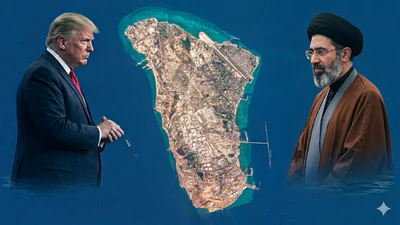
PERSIAN GULF – As rhetoric between Washington and Tehran reaches a fever pitch, military analysts and global energy markets have fixed their gaze on a small, T-shaped limestone outcrop: Kharg Island.
While often overshadowed by the diplomatic sparring in New York or drone skirmishes in the Levant, this island represents the single most vulnerable artery in Iran’s economy—and the most likely “ground zero” for a decisive military escalation.
The Economic Jugular
Kharg Island is not merely a military outpost; it is the lifeblood of the Islamic Republic. Handling roughly 90% of Iran’s crude oil exports, the island serves as the primary terminal for the country’s state-owned oil enterprise.
For the United States and its allies, Kharg presents a “surgical” target. In the event of a full-scale conflict, disabling the island’s deep-water berths would effectively:
Zero out Iran’s foreign currency reserves overnight.
Paralyze the government’s ability to fund regional proxies.
Trigger a global oil price shock that could see Brent crude soar past $150 a barrel.
The “Ground Invasion” Logic
Speculation regarding a ground invasion often centers on Kharg because of its geography. Unlike the Iranian mainland—a mountainous fortress nearly the size of Alaska—Kharg is only 15 square miles.
Military strategists suggest that while a full-scale invasion of Iran remains a logistical nightmare, a limited amphibious operation to seize or neutralize Kharg Island is a more “attainable” military objective. By occupying the island, an adversary could hold Iran’s entire economy hostage without having to commit to a long-term “forever war” on the mainland.
Iran’s “Scorched Sea” Defense
Tehran is well aware of its Achilles’ heel. The island is currently one of the most heavily defended patches of land on Earth, featuring:
S-300 Surface-to-Air Missile (SAM) batteries to deter aerial strikes.
Hardened coastal artillery and “swarm” motorboat bases.
Extensive radar arrays monitoring the Strait of Hormuz.
Iranian officials have repeatedly warned that any move against Kharg would be met with the closure of the Strait of Hormuz. This “scorched sea” policy ensures that if Iran cannot export oil, the rest of the world won’t either.
Why Now?
The shift from “cold” to “hot” tension is driven by the collapse of previous maritime de-escalation agreements. With Western intelligence pointing toward increased Iranian enrichment levels and renewed attacks on shipping lanes, the U.S. has bolstered its presence in the 5th Fleet.
“Kharg Island is the ultimate ‘Doomsday Switch,'” says Dr. Helena Vance, a senior fellow at the Center for Maritime Security. “If a single boot hits the sand there, the era of shadow boxing is over. It’s the one place where a local skirmish turns into a global catastrophe.”
Global Implications: The $100 Billion Risk
The stakes extend far beyond the Gulf. A conflict centered on Kharg Island would disrupt the flow of energy to China and India, Iran’s primary customers, potentially forcing Beijing to intervene diplomatically—or militarily—to protect its energy security.
As the drums of war beat louder, Kharg Island remains the world’s most precarious balancing act: a tiny island holding the weight of global stability.