
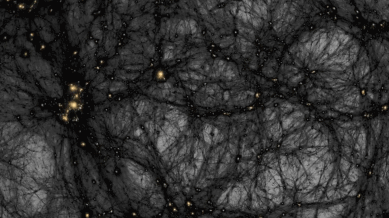
Source The Indian Express
TOKYO/WASHINGTON D.C. — In a potentially monumental breakthrough, a new analysis of data from NASA’s Fermi Gamma-ray Space Telescope has revealed a distinct gamma-ray signature at the center of the Milky Way galaxy that closely matches theoretical predictions for dark matter annihilation.
For nearly a century, dark matter—the mysterious, invisible substance believed to make up about 85% of the universe’s total mass—has only been inferred through its gravitational effects on visible matter. It has remained one of science’s most enduring puzzles, as it neither emits nor absorbs light, making it inherently “dark.”
The Galactic Glow: A Dark Matter Footprint
The new findings, published in the Journal of Cosmology and Astroparticle Physics by a team led by Professor Tomonori Totani from the University of Tokyo, focus on a halo-shaped glow of gamma rays centered around the galactic core.
The Signature: The detected gamma rays have a specific energy of approximately 20 gigaelectronvolts (GeV).
The Shape: Crucially, the spatial distribution of this gamma-ray emission is spherical and closely matches the predicted shape of the massive dark matter halo thought to surround our galaxy.
This specific spectral and spatial pattern is exactly what is anticipated if dark matter is composed of Weakly Interacting Massive Particles (WIMPs)—a leading dark matter candidate. The theory suggests that when two WIMPs collide, they annihilate, producing a burst of particles, including high-energy gamma-ray photons that the Fermi telescope is designed to capture.
A “First Sight” of the Unseen?
Professor Totani states that no other known astrophysical phenomena can easily explain both the energy signature and the halo-like distribution of the observed gamma rays.
“If this is correct, to the extent of my knowledge, it would mark the first time humanity has ‘seen’ dark matter,” said Professor Totani. He added that the discovery suggests dark matter is a new particle, not accounted for in the current Standard Model of particle physics, and is likely a particle at least 500 times more massive than a proton.
If confirmed, this discovery would necessitate a significant revision of the Standard Model and mark a major development in both astronomy and particle physics.
Caution and Next Steps
While the findings are compelling, the scientific community is urging caution. Previous potential signals of dark matter have ultimately been attributed to other astrophysical sources, such as rapidly spinning stars (pulsars) or cosmic-ray interactions.
Independent verification is the vital next step. Researchers will need to perform similar analyses using different data sets or look for the predicted annihilation signal in other high-density dark matter regions, such as smaller satellite galaxies, to rule out alternative explanations completely. The longevity of the Fermi-LAT observations, which span more than fifteen years, helps to rule out transient events, but further confirmation is essential to solidify this claim as humanity’s first direct glimpse of the universe’s most abundant, yet elusive, matter.









