
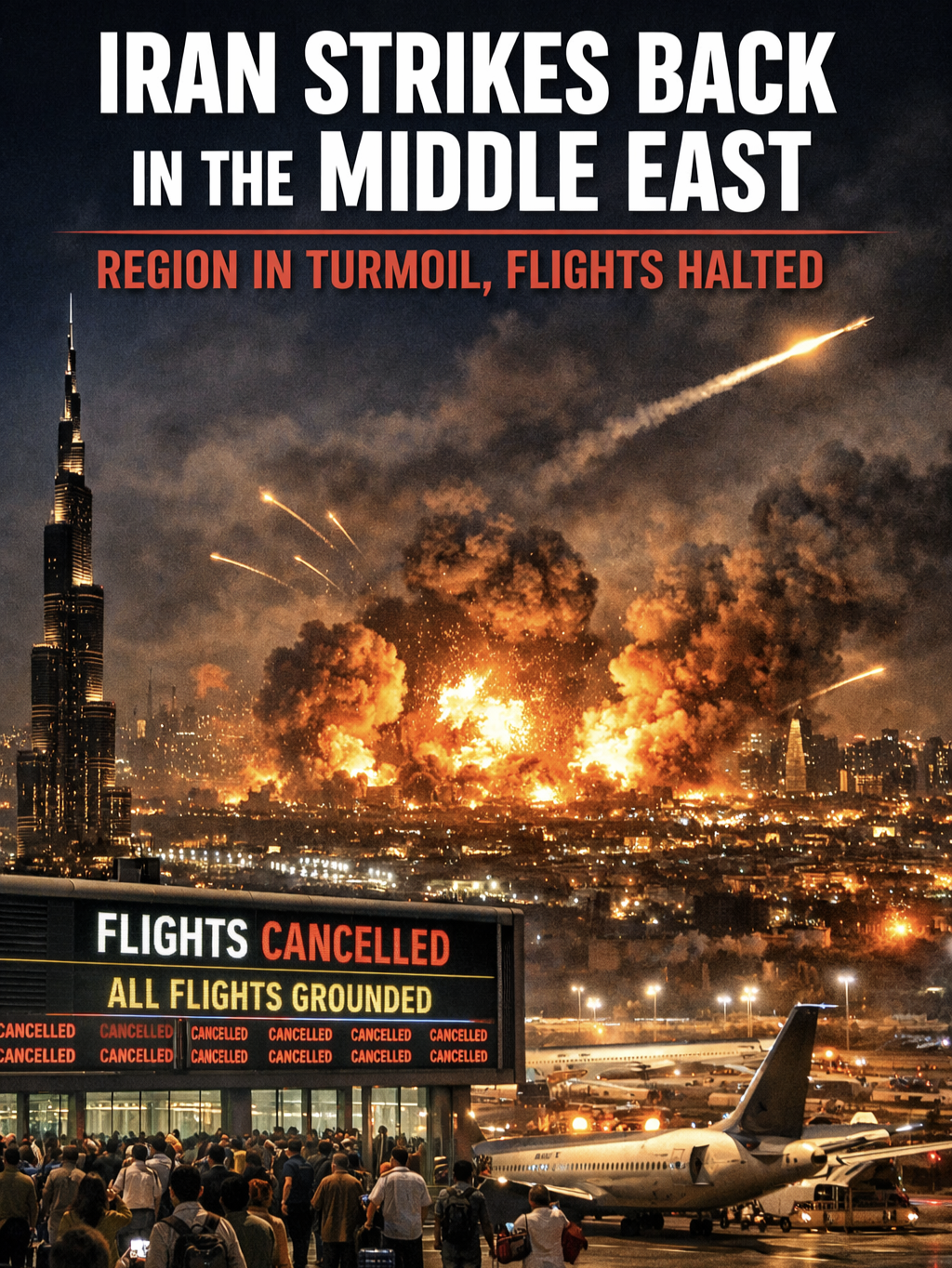
Explosions have been reported across multiple countries in the Middle East as Iran launched retaliatory missile and drone strikes in response to joint military attacks by the United States and Israel earlier on Saturday. The rapidly evolving crisis has disrupted civilian life and grounded flights across the region.
Residents in capitals including Abu Dhabi, Dubai, Doha, Riyadh, Manama, and Amman heard multiple loud blasts and saw smoke rising into the sky, according to international news agencies and eyewitness accounts. Authorities in Gulf states reported intercepting a number of incoming missiles with air-defense systems.
In the UAE, debris from intercepted missiles struck a residential area in Abu Dhabi, killing at least one civilian, officials said. Dubai’s iconic Burj Khalifa was evacuated as a precaution while residents reported explosions and air-raid alerts.
Qatar’s capital Doha sounded national emergency alarms as explosions echoed and officials said they successfully repelled attacks on their territory. Similar reports of intercepted missiles and explosions came in from Saudi Arabia and Bahrain.
The escalation follows a coordinated military operation by the U.S. and Israel against Iranian military facilities and leadership positions earlier in the day, in what Washington described as a “major combat operation.” In retaliation, Iran’s Revolutionary Guards said they had launched strikes against U.S. military assets and bases in the region, promising sustained operations.
Impact on Air Travel
The intensifying conflict has severely disrupted aviation across the Middle East. Airspace closures and cautionary advisories have forced airlines to cancel or reroute flights between Europe, Asia, and North America, particularly those that normally transit Gulf skies. Several major carriers have suspended flights to and from airports in the affected region amid safety concerns.
Dubai International Airport—one of the world’s busiest hubs—announced a temporary suspension of all operations, while airspace closures were also reported over Iran, Iraq, Kuwait, and the UAE. Passengers have faced cancellations, delays, and scrambled travel plans as carriers issue travel advisories.
Diplomatic Tensions and Wider Concerns
Global leaders have reacted with concern to the spiraling conflict. Regional powers condemned the escalation, and the United Nations Security Council convened an emergency session to discuss steps to prevent further destabilization. The oil markets also showed signs of volatility, given the strategic importance of the Gulf region.
As the situation continues to unfold, international calls for de-escalation and diplomatic engagement are mounting, but there are fears of a wider, protracted confrontation involving multiple actors across the Middle East.









