Source India Today
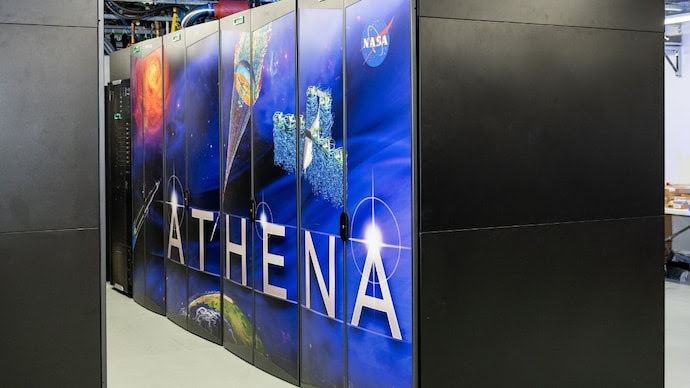
SILICON VALLEY – NASA has officially unveiled its most formidable computational weapon to date: Athena. Housed at the Ames Research Center in California, this modular supercomputing titan is designed to handle the staggering data demands of the Artemis II lunar mission and beyond.
While a high-end consumer PC is impressive for gaming or video editing, Athena operates on a scale that defies standard comparison. Engineers estimate that complex simulations Athena completes in just 24 hours would take a standard desktop computer approximately 500 years to process.
The Power of 20 Quadrillion Calculations
At the heart of Athena’s dominance is its peak performance of 20 petaflops. To put that in perspective, one petaflop equals one quadrillion (10^{15}) floating-point operations per second.
Technical Specifications at a Glance
Feature Athena Specifications
Peak Performance 20.132 Petaflops/s
Total Processor Cores 264,144
System Memory 786 Terabytes (TB)
Architecture HPE Cray EX4000 (Liquid-Cooled)
Nodes 1,024 (Dual 128-core AMD EPYC sockets)
Why NASA Needs This Much Speed
Athena isn’t just about raw numbers; it is the “digital backbone” for humanity’s return to the Moon. NASA scientists are utilizing the system for high-stakes research that requires extreme precision:
Rocket Launch Simulations: Modeling the volatile fluid dynamics of fuel and airflow during liftoff.
Artemis II Planning: Analyzing safety risks and orbital mechanics for the first crewed lunar flight in over half a century.
Climate Modeling: Processing massive Earth science datasets to predict global weather patterns with unprecedented resolution.
AI Training: Powering large-scale artificial intelligence models to sift through petabytes of deep-space imagery.
“With Athena, we are laying the digital foundation for the next era of discovery,” NASA stated during the unveiling. “It allows us to run thousands of ‘what-if’ scenarios before a single bolt is even tightened on a spacecraft.”
Efficiency in a Box
Despite its terrifying power, Athena is a model of modern green tech. It lives within NASA’s Modular Supercomputing Facility (MSF), a flexible setup that uses advanced outdoor air-cooling and liquid-cooling techniques. This design allows it to be significantly more energy-efficient than its predecessors, Aitken and Pleiades, saving millions of gallons of water and reducing utility costs for the agency.
As NASA pushes further into the cosmos, the ability to calculate faster, safer, and more efficiently ensures that the next “giant leap” is backed by the most powerful tools ever built.