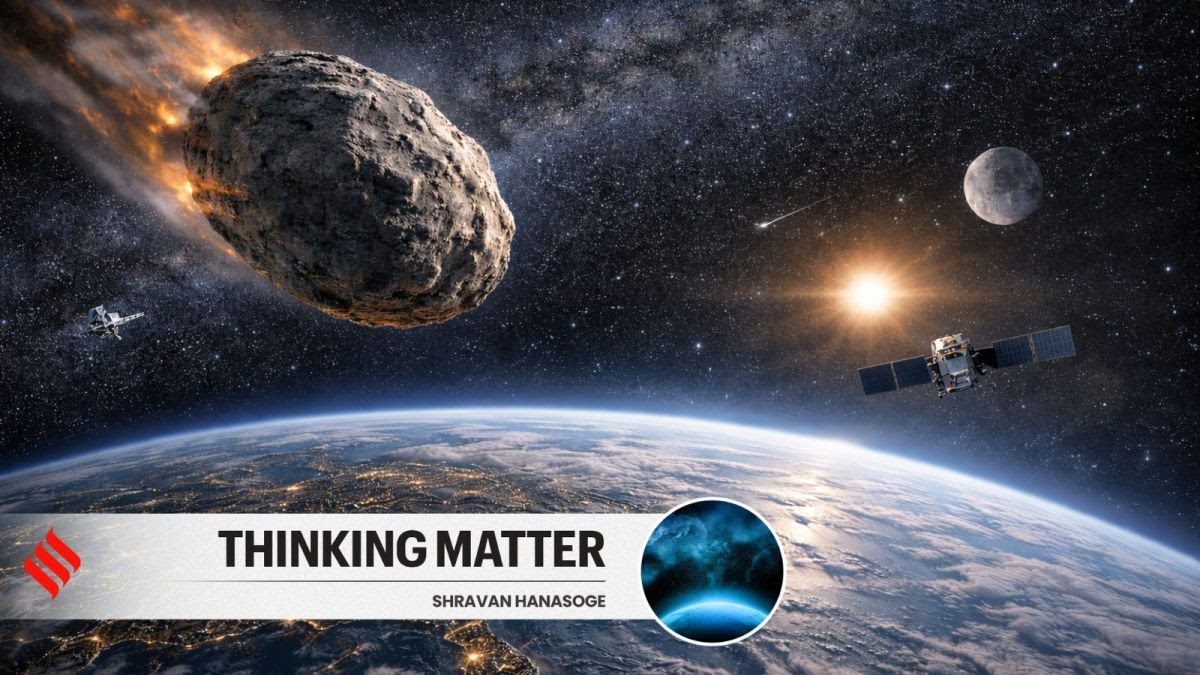
Source The Indian Express
(Earth) – The idea of a massive asteroid hurtling towards Earth has long been a staple of science fiction, but recent technological advancements are making the possibility of a real-life interception a serious conversation among scientists. With the discovery of near-Earth asteroids that could pose a potential threat, the question arises: can we stop them?
The potential for an asteroid impact is a sobering reality. Throughout Earth’s history, large asteroids have had a significant impact, causing mass extinctions and reshaping the planet’s environment. While the probability of a major impact is low, the potential consequences are devastating.
Scientists have been working to identify and track potentially hazardous asteroids, developing systems that could potentially deflect or destroy them. Several techniques are being explored, including kinetic impactors, gravity tractors, and laser deflection.
Kinetic impactors involve sending a spacecraft to crash into the asteroid, altering its trajectory. This technique has been tested on a smaller scale, and scientists are optimistic about its potential effectiveness against larger asteroids.
Gravity tractors, on the other hand, are a more subtle approach. They involve placing a spacecraft near the asteroid and using its gravitational pull to gently nudge it onto a safer path. This technique requires a long lead time but could be effective for smaller asteroids.
Laser deflection is a newer and more experimental approach that involves using high-powered lasers to vaporize a portion of the asteroid’s surface. The resulting thrust would then push the asteroid in a different direction.
While these techniques offer promising possibilities, there are significant challenges to overcome. The size and composition of the asteroid, its distance from Earth, and the timing of the interception are all critical factors that would determine the success of any deflection mission.
Furthermore, the cost of developing and deploying such systems is substantial, requiring global cooperation and investment. Some scientists have expressed concerns about the potential for unintended consequences, such as the breakup of the asteroid into smaller fragments that could still pose a threat.
Despite these challenges, the consensus among scientists is that the ability to deflect an asteroid is a feasible goal. With continued research and investment, we may be able to protect Earth from the potentially devastating consequences of a celestial impact.
The search for asteroids that could pose a threat to Earth continues, with new discoveries made regularly. The development of deflection technologies is also ongoing, with scientists working to refine existing techniques and explore new possibilities.
The potential for an asteroid impact is a serious issue that demands our attention. While the risk is low, the consequences are severe. By investing in asteroid deflection technologies and promoting global cooperation, we can increase our chances of protecting our planet from a celestial disaster.