
Source The Indian Express
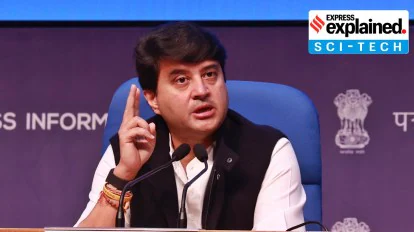
NEW DELHI—Union Communications Minister Jyotiraditya Scindia on Tuesday sought to allay widespread concerns over privacy and user data by clarifying that the government-backed cybersecurity application, Sanchar Saathi, is optional for users despite being mandated for pre-installation on all new mobile devices.
The clarification comes in the wake of a Department of Telecommunications (DoT) directive asking smartphone manufacturers to pre-install the Sanchar Saathi app, making it “readily visible and accessible” with no option to “disable or restrict” its functionalities. This move immediately triggered a backlash from privacy activists, the Opposition, and users, who feared it could be a tool for state-led surveillance and regulatory overreach.
Minister’s Assurance: No Snooping Possible
Speaking to reporters outside the Parliament, and later confirming on social media, Mr. Scindia categorically stated that the app is a citizen-safety tool rooted in Jan Bhagidaari (public participation), not a surveillance mechanism.
“Snooping is neither possible nor will it happen with the Sanchar Saathi safety app,” the Minister asserted. “This is a completely voluntary and democratic system. Users have complete freedom to activate or delete the app at any time, ensuring safety without compromising privacy.”
He elaborated that while the app’s pre-installation is being mandated to ensure every citizen is aware of and has access to the digital security tool, its activation and continued use are entirely up to the user. If a user does not register, the app will remain dormant.
🤔 Key Concerns and App Functionality
The Sanchar Saathi portal and app were launched to empower mobile subscribers, strengthen security, and combat cyber fraud. Its primary features include:
Blocking and Tracking lost or stolen mobile phones via their IMEI number.
Checking all mobile connections registered under a user’s name to identify and report fraudulent numbers.
Reporting suspected scam calls and messages through the ‘Chakshu’ facility.
Verifying the genuineness of a mobile handset using its IMEI.
The privacy concerns raised stem from the fact that on Android devices, system-level pre-installed apps can potentially access sensitive permissions (like call logs and SMS) without explicit user consent, leading to fears of unauthorized data collection and monitoring, despite the government’s assurances.
⚖️ The Road Ahead: DoT Order vs. Minister’s Statement
The central point of contention remains the disconnect between the Minister’s reassuring statement and the DoT’s official November 28 order, which specified that the app’s functionalities cannot be “disabled or restricted.” Critics argue that true optionality cannot coexist with compulsory pre-installation and a “no restriction” mandate, which could technically keep the app active in the background.
Despite the continuing debate, Mr. Scindia’s intervention attempts to defuse the political row by placing the power of choice squarely back with the consumer. The government has maintained that minimal data is collected and only for the purpose of combating fraud, with adherence to the Information Technology Act, 2000. It remains to be seen if the government will amend the DoT order to explicitly include an uninstall or full disable option to align the policy with the Minister’s verbal assurances.









