
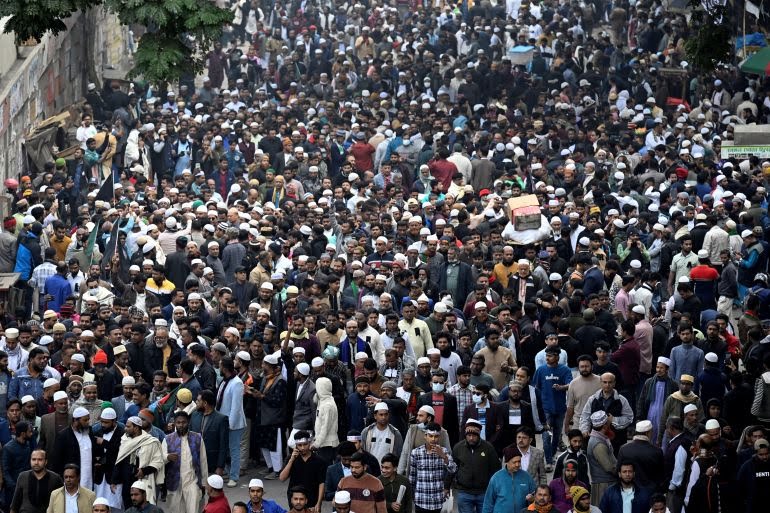
Source Aljajeera
DHAKA — Hundreds of thousands of mourners flooded the streets of the capital on Wednesday to attend the state funeral of Begum Khaleda Zia, Bangladesh’s first female prime minister and a titan of its political history. Zia, who died Tuesday at the age of 80 following a prolonged illness, was laid to rest with full state honors beside her husband, the late President Ziaur Rahman.
A Nation in Mourning
The government of Bangladesh declared a three-day period of national mourning, with flags flying at half-mast across all government and semi-government buildings. From the early hours of Wednesday, a “sea of people” began converging on the South Plaza of the Jatiya Sangsad (Parliament) complex for the Namaz-e-Janaza (funeral prayers).
Mourners traveled from across the country—some journeying overnight from districts like Feni, Bogra, and Chittagong—to catch a final glimpse of the leader who served three terms as Prime Minister. The atmosphere was one of somber reflection, marked by tears and prayers, as the flag-draped coffin was escorted by a military guard of honor.
Global and Local Tributes
The funeral was attended by the highest levels of the Bangladeshi interim government and foreign dignitaries, signaling Zia’s enduring influence on regional geopolitics:
Chief Adviser Muhammad Yunus joined the funeral prayers, describing Zia as a “symbol of the democratic movement” and praising her resilience.
India’s External Affairs Minister S. Jaishankar arrived in Dhaka to represent the Government of India. He handed over a personal condolence letter from Prime Minister Narendra Modi to Zia’s son, Tarique Rahman, who recently returned from 17 years of exile.
Representatives from Pakistan, Nepal, and several Western diplomatic missions were also in attendance to pay their respects.
The End of an Era
Khaleda Zia’s passing marks the conclusion of a defining chapter in Bangladesh’s history. For over three decades, the nation’s politics were shaped by her fierce rivalry with Sheikh Hasina. Known for her “uncompromising” stance during the pro-democracy movements of the 1980s, Zia rose to power in 1991, ushering in a new era of parliamentary democracy.
Despite years of legal battles and failing health—suffering from liver cirrhosis, heart complications, and diabetes—she remained the undisputed matriarch of the Bangladesh Nationalist Party (BNP).
Final Rites
Following the funeral prayers, the procession moved toward Sher-e-Bangla Nagar. Under heavy security, her body was interred at Chandrima Uddan, beside the grave of her husband, Ziaur Rahman.
As the sun set over Dhaka, the BNP announced an additional seven-day period of mourning within the party. For many of the millions who gathered today, Zia was more than a politician; she was “Deshnetri” (Leader of the Country), a figure whose legacy will continue to cast a long shadow over the upcoming February elections.









