
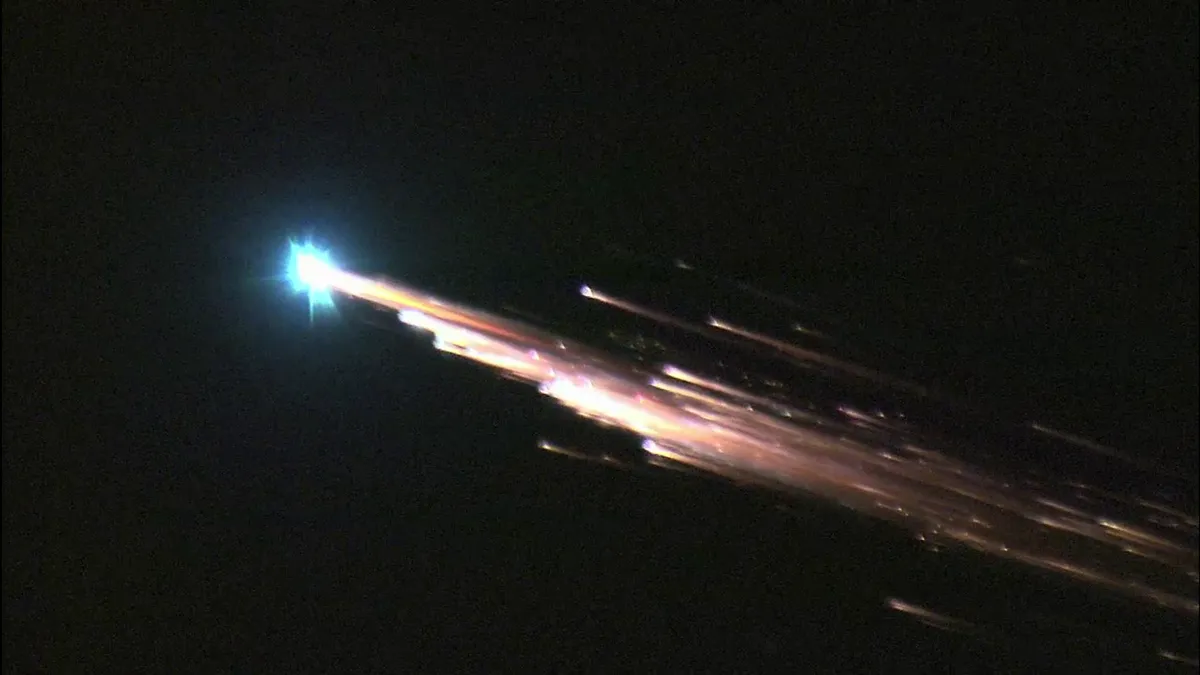
Source space
VANCOUVER – For decades, earthquake sensors (seismometers) have been tuned to the internal groans of our planet—tectonic plates shifting, volcanic magma rising, or the occasional nuclear test. Now, these ultra-sensitive devices are being recruited for a much noisier task: tracking the “corpses” of satellites as they slam into the atmosphere.
As the low-Earth orbit becomes increasingly crowded, the frequency of retired satellites and rocket stages falling back to Earth is skyrocketing. While most debris burns up, larger pieces often survive the heat of re-entry. New research suggests that the seismic waves generated by these impacts—and the sonic booms preceding them—offer a revolutionary way to track space junk with “pinpoint” accuracy.
The “Thump” from Above
When a piece of space debris enters the atmosphere at hypersonic speeds, it creates a powerful shockwave. If the object is large enough to strike the ground or the ocean, it generates a distinct seismic signature.
Researchers have found that global seismic networks can detect these events even in remote areas where traditional radar or optical telescopes can’t “see.”
Sonic Booms: Seismometers pick up the air-to-ground coupling of the shockwave.
Impact Points: By triangulating the arrival time of the vibrations, scientists can locate a crash site within meters.
Mass Estimation: The intensity of the “thump” helps experts estimate the size and density of the fallen object.
Why It Matters
Tracking re-entries isn’t just a matter of scientific curiosity; it’s a growing safety concern. “Space is getting congested,” says Dr. Elena Rossi, an orbital mechanics specialist. “Knowing exactly where and when a satellite hits the Earth helps us refine our orbital models and protects maritime and aviation corridors.”
Current tracking methods often rely on radar, which can be expensive and limited by geography. Seismometers, however, are already buried all over the globe, providing a “built-in” planetary alarm system for falling debris.
Comparison of Tracking Methods
Feature Satellite Radar Seismic Sensors
Visibility Requires line-of-sight Works through ground vibration
Cost High (Requires dedicated tech) Low (Uses existing networks)
Precision High in orbit High at point of impact
Coverage Regional Global / Remote
“The Earth itself is acting like a giant microphone,” says one researcher. “We’re finally learning how to listen to the debris falling from the sky.”









