Source The Hindu
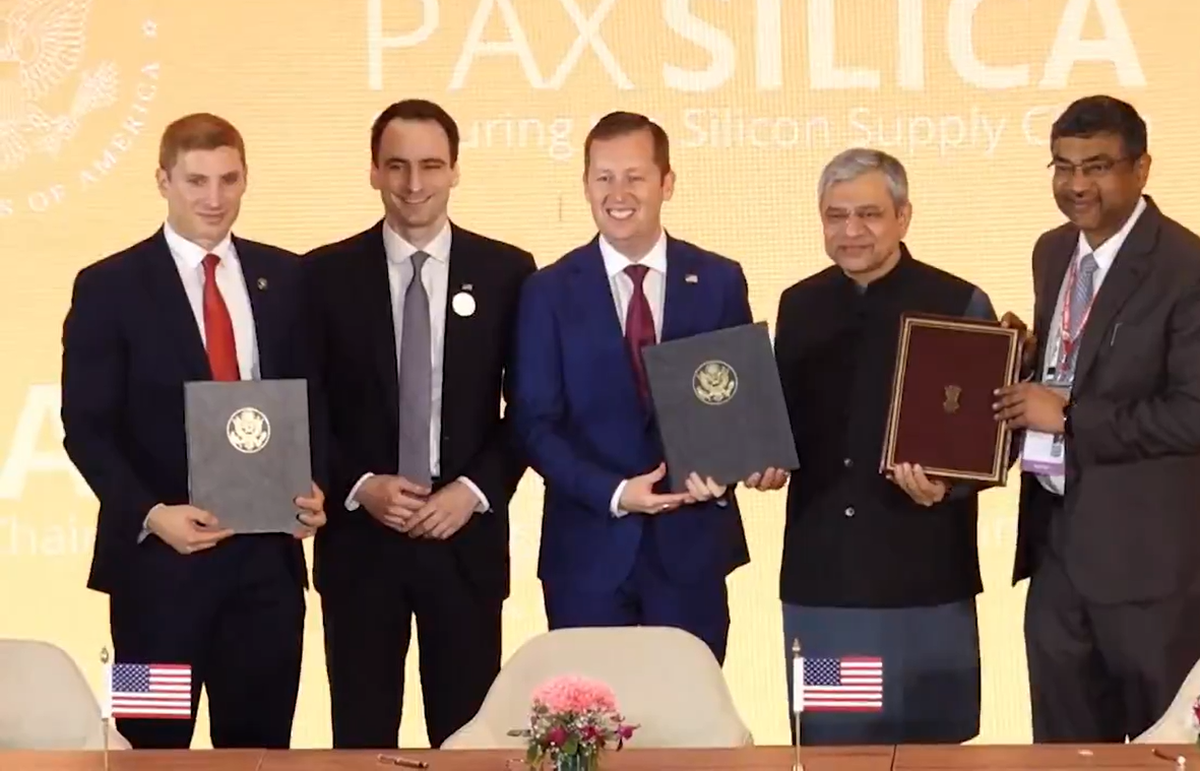
NEW DELHI – In a move that redraws the global map of technological power, India has formally joined Pax Silica, a high-stakes strategic coalition led by the United States. The agreement was signed on Friday, February 20, 2026, during the India AI Impact Summit in New Delhi, making India the tenth nation to join the elite group.
The partnership, described by diplomats as a “coalition of capabilities,” is designed to secure the “silicon stack”—the entire supply chain ranging from the mining of critical minerals to the fabrication of advanced semiconductors and the deployment of frontier Artificial Intelligence (AI).
A Strategic Pivot for the Global South
The signing ceremony was attended by Union Minister for Electronics and IT Ashwini Vaishnaw, U.S. Ambassador to India Sergio Gor, and U.S. Under Secretary of State Jacob Helberg.
For New Delhi, the move represents a decisive pivot toward a “trusted” global technology ecosystem. By joining Pax Silica, India aligns itself with other tech powerhouses, including Japan, South Korea, Singapore, Australia, Israel, and the United Kingdom.
“India’s entry into Pax Silica is not just symbolic; it is strategic and essential,” said Ambassador Sergio Gor. “It’s about whether the 21st-century order is built in Bengaluru and Silicon Valley or in surveillance states. Today, we choose freedom and partnership.”
Key Pillars of the Agreement
The Pax Silica Declaration focuses on four critical areas of cooperation:
Semiconductor Resilience: Accelerating India’s goal to become a global chip hub, including collaboration on 2-nanometer chip design.
Critical Mineral Security: Establishing “price floors” and secure corridors for lithium, cobalt, and rare earth elements to prevent market manipulation.
AI Infrastructure: Massive investments in data centers and “compute” capacity to ensure that AI development remains in the hands of democratic nations.
Supply Chain Diversification: Reducing “coercive dependencies” on single-source suppliers, a move widely viewed as a strategy to decouple critical tech from Chinese dominance.
The “India Factor”
With a median age of 28 and a massive pool of engineering talent, India is seen as the “talent engine” of the coalition. Minister Ashwini Vaishnaw emphasized that the partnership would yield compounding benefits for decades, noting that the global semiconductor industry will require over one million additional skilled workers—a gap India is uniquely positioned to fill.
Market analysts suggest the deal will trigger a surge in investments in India’s tech and mining sectors. “This is a roadmap for the next 50 years of growth,” Vaishnaw remarked, highlighting that the alliance secures India’s place as a primary architect of the AI revolution.