
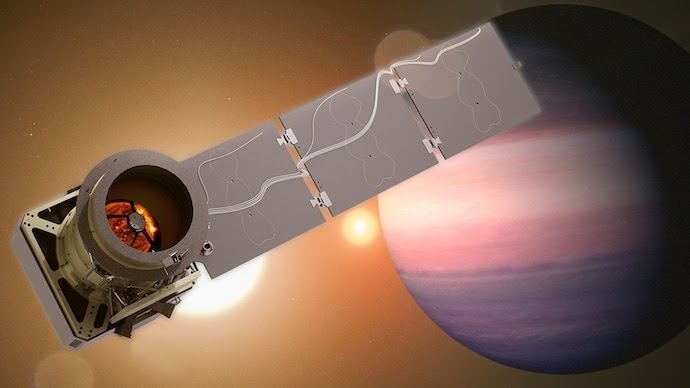
Source India Today
VANDENBERG SPACE FORCE BASE, CA – In a pre-dawn spectacle on January 11, 2026, a SpaceX Falcon 9 rocket roared into the California sky, carrying a vital new tool for the hunt for habitable worlds: NASA’s Pandora satellite.
The mission, which successfully reached its sun-synchronous orbit, marks the first launch of NASA’s Astrophysics Pioneers program, an initiative designed to conduct high-impact science using small, low-cost satellites.
Disentangling the Secrets of Distant Stars
While giant observatories like the James Webb Space Telescope (JWST) can “see” deep into space, they often face a problem called stellar contamination. When a planet passes in front of its star (a transit), the star’s own spots and flares can mimic the signals of a planet’s atmosphere, making it hard to tell what belongs to the world and what belongs to the sun.
Pandora’s primary mission is to solve this “identity crisis.” Equipped with a specialized 45-centimeter (18-inch) all-aluminum telescope, the satellite will simultaneously monitor stars in visible light and their planets in near-infrared.
“Pandora’s goal is to disentangle the atmospheric signals of planets and stars,” says Elisa Quintana, the mission’s principal investigator at NASA’s Goddard Space Flight Center. “By doing this, we can finally determine if a planet’s atmosphere contains water, clouds, or hazes with absolute certainty.”
Mission Highlights at a Glance
The Pandora mission is a masterclass in efficiency, utilizing spare parts—including an infrared sensor originally built for the James Webb Space Telescope—to keep costs under the $20 million cap.
Feature Details
Primary Target At least 20 exoplanets and their host stars
Observation Style 10 “stares” per system, each lasting 24 hours
Key Molecules Searching for Hydrogen and Water
Launch Vehicle SpaceX Falcon 9 (Twilight Rideshare)
Orbit Sun-Synchronous (600 km altitude).
A Global Search for Habitability
Over its planned one-year mission, Pandora will observe more than 200 planetary transits. It will focus on planets ranging from Earth-sized rocky worlds to gas giants like Jupiter. By identifying which planets have water-dominated atmospheres and which are covered in obscuring clouds, Pandora will provide a “shortlist” of the most promising candidates for JWST to investigate for signs of life.
The spacecraft’s successful acquisition of signal on January 12 confirms that all systems are nominal. After a month of commissioning and testing, Pandora will begin its deep-space “stare” to unlock the mysteries of the cosmos.









