
Source HT
NEW DELHI — Prime Minister Narendra Modi’s high-profile state visit to Israel has ignited a firestorm of domestic and international criticism, with opposition leaders labeling the trip an act of “moral cowardice” following the launch of joint US-Israeli military strikes on Iran just hours after his departure.
The Prime Minister concluded his two-day visit on February 26, 2026, during which he addressed the Knesset and reaffirmed that India stands “firmly, with full conviction” with Israel. However, the timing of the visit has come under intense scrutiny as the Middle East teeters on the brink of a wider regional war.
A “Shameful” Endorsement?
The Indian National Congress led the charge against the government, describing the visit as “ill-timed” and “shameful.” Jairam Ramesh, Congress General Secretary in charge of Communications, took to social media to slam the Prime Minister’s diplomatic choices.
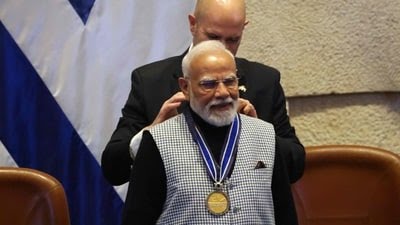
“Mr. Modi nevertheless chose to go to Israel, where he displayed the highest moral cowardice,” Ramesh stated. “He declared that India stood with Israel and got himself an award for saying so. This visit is even more shameful in light of the war launched by two of Mr. Modi’s ‘good friends’ [Netanyahu and Trump].”
The opposition argues that the visit creates a perception of political endorsement for military escalation, moving India away from its historic commitment to a rules-based international order and strategic neutrality.
Geopolitical Fallout
The controversy centers on several key developments during and after the trip:
The Knesset Address: PM Modi referred to Israel as a “protective wall against barbarism,” language critics argue mirrors the rhetoric used by the Netanyahu administration to justify its military campaigns.
The Iran Strikes: On February 28, 2026, the US and Israel launched what they termed “preventive strikes” against military targets in Iran. Critics question whether the Indian government had prior knowledge of the impending assault.
Strategic Autonomy: Analysts suggest that the deepening embrace of Israel—elevated during this trip to a “Special Strategic Partnership”—risks alienating India’s partners in the Arab world and Iran, where millions of Indian expats live and work.
Government Defense
The Ministry of External Affairs (MEA) has dismissed the “moral cowardice” labels, framing the visit as a necessary step for India’s technological and defense future. A joint statement released following the visit highlighted 27 new agreements in areas including:
Artificial Intelligence (AI) and Semiconductors.
Quantum Computing and Cybersecurity.
The IMEC Corridor: Strengthening the India-Middle East-Europe Economic Corridor.
Official sources maintain that India’s relationship with Israel is independent of its ties with other regional powers and that the Prime Minister explicitly expressed support for a “Gaza Peace Plan” during his talks with President Isaac Herzog.
The Road Ahead
As the conflict between the US-Israel alliance and Iran intensifies, the Modi government faces the daunting task of balancing its “Special Strategic Partnership” with Israel against the potential backlash from the Global South and the energy-rich Gulf nations.
For now, the image of PM Modi standing in the Knesset just 48 hours before missiles fell on Tehran remains a polarizing symbol of India’s evolving—and increasingly controversial—foreign policy.









