
Source AI
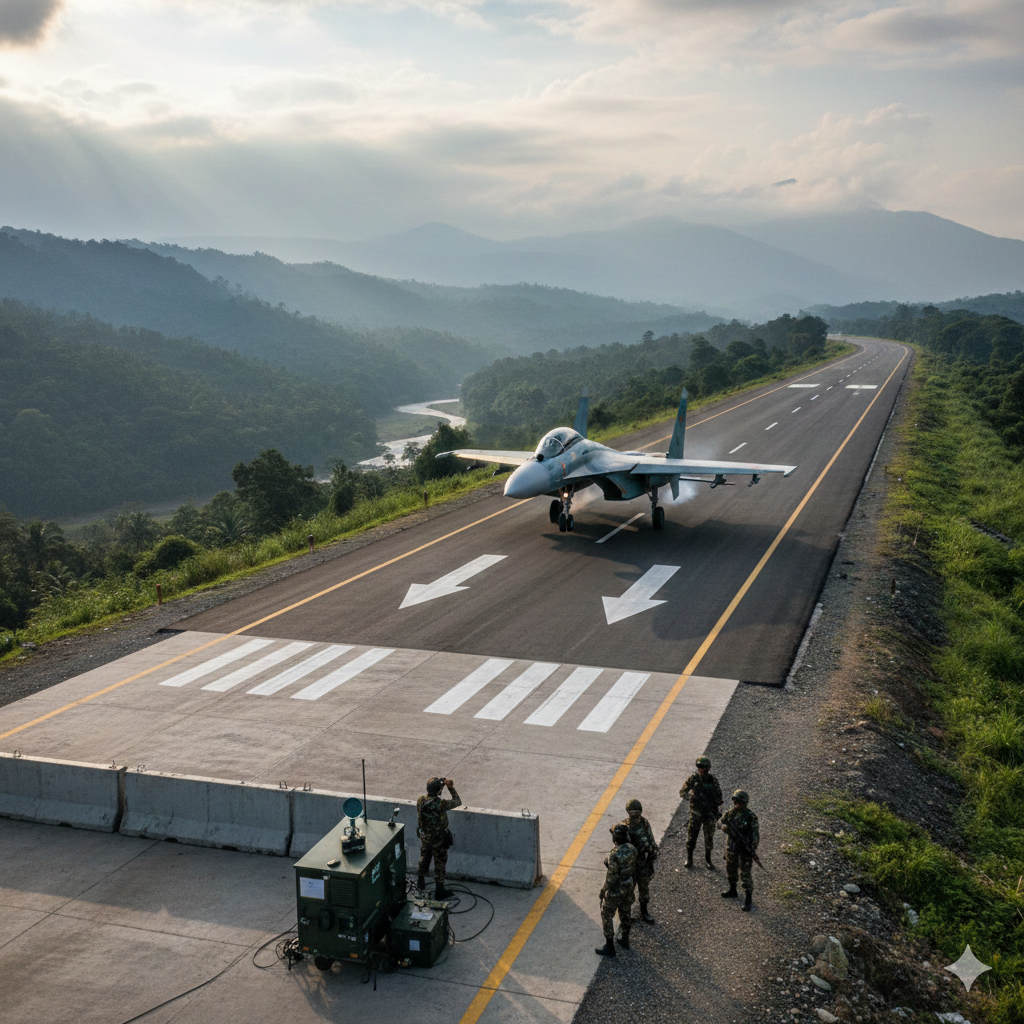
ZEMABAWK, Mizoram – In a move that signals a significant shift in India’s frontier defense strategy, the National Highways and Infrastructure Development Corporation Limited (NHIDCL) has completed the Northeast’s first Emergency Landing Facility (ELF) on a strategic highway.
While the project is framed as a boost for regional connectivity and disaster management, defense analysts and government officials confirm that the primary driver behind this rapid infrastructure push is the escalating security dynamic along the Line of Actual Control (LAC) with China.
A Tactical Shift in the Mountains
Historically, the rugged terrain of Northeast India has been a logistical nightmare for the Indian Air Force (IAF). The new 2.5-kilometer stretch of highway, specifically reinforced to withstand the impact of heavy fighter jets, serves as a “force multiplier.”
By converting sections of National Highways into makeshift airbases, India is effectively creating decentralized runways. This ensures that even if main airbases in the region are targeted or rendered unusable during a conflict, the IAF can maintain air superiority and logistical supply lines.
Why China is the Catalyst
The timing of the project isn’t accidental. Following the 2020 Galwan standoff and continued infrastructure buildup by the People’s Liberation Army (PLA) in Tibet, New Delhi has pivoted toward “proactive defense.”
Countering “A2/AD” Capabilities: China has invested heavily in Anti-Access/Area Denial (A2/AD) systems. Dispersing aircraft across highway strips makes it significantly harder for an adversary to neutralize the Indian fleet in a single strike.
Rapid Deployment: The ELF allows for the swift movement of troops and heavy equipment to forward positions in Arunachal Pradesh and Sikkim, areas where China has recently increased its territorial claims.
Dual-Use Strategy: Mirroring China’s own “Civil-Military Fusion,” these runways serve civilian rescue operations during the monsoon season while remaining “combat-ready” at a moment’s notice.
Engineering for Combat
Unlike standard asphalt, the ELF is constructed with specialized high-grade concrete and features:
Zero-Obstruction Zones: Cleared perimeters to allow for low-altitude approaches.
Reinforced Hardstanding: Specific areas for parking and refueling aircraft.
Quick-Deploy Communication: Hidden conduits for mobile Air Traffic Control (ATC) units.
“The Northeast is no longer the ‘neglected frontier.’ Every kilometer of road being built now has a dual purpose: to connect the people and to protect the borders,” says a senior official involved in the project.
The Road Ahead
This runway is just the beginning. The Ministry of Road Transport and Highways, in coordination with the IAF, has identified several more sites across the “Chicken’s Neck” corridor and deep into Arunachal Pradesh for similar facilities.
As the “Dragon” continues to fortify the high-altitude plateaus of Tibet, India is ensuring that its response is paved in concrete—right on its highways.









