
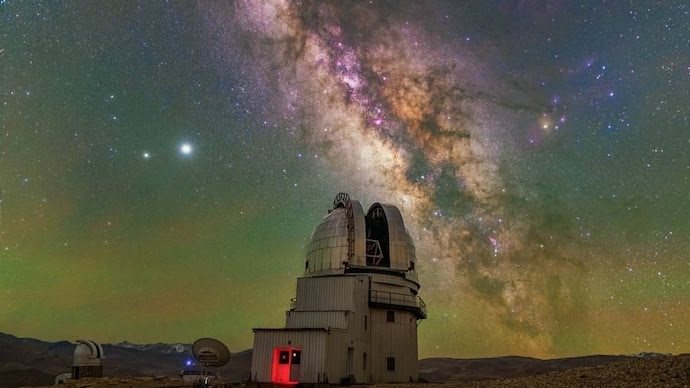
Source India Today
NEW DELHI — For millennia, the Indian night sky was a canvas of myth and navigation. From the Seven Sages (Saptarishi) guiding travelers to the precise calculations of ancient astronomers, the stars have been central to the nation’s cultural and scientific identity. Today, however, that celestial heritage is dissolving into a murky, orange haze.
Recent satellite data and citizen-science observations suggest that light pollution across the Indian subcontinent is increasing at an alarming rate, far outstripping the pace of population growth. As cities expand and rural electrification shifts toward high-intensity, unshielded LEDs, the “natural night” is becoming a relic of the past.
The Death of the Milky Way
In major metros like Mumbai, Delhi, and Bengaluru, the Milky Way—our own galaxy—is now entirely invisible to the naked eye. What was once a brilliant river of stars is now a blank void.
This isn’t just a loss for romanticists or poets. The disappearance of the stars marks the onset of Ecological Light Pollution (ELP).
Disrupted Ecosystems: Migratory birds, which navigate using stellar cues, are becoming disoriented by the “skyglaze” of urban centers.
Human Health: Constant exposure to artificial light at night inhibits the production of melatonin, disrupting circadian rhythms and increasing risks of sleep disorders.
Scientific Setback: India’s premier observatories, such as those in Hanle, Ladakh, are some of the last bastions of true darkness, but even these “Dark Sky Reserves” face threats from encroaching infrastructure.
The “LED” Paradox
While the shift to LED lighting has been praised for energy efficiency, it has inadvertently accelerated the erasure of the stars. Many streetlights installed under recent modernization schemes use “cool” blue-rich white light. This specific spectrum scatters more easily in the atmosphere, creating a dome of artificial light that can be seen from dozens of miles away.
“We are the first generation of humans to live in a world where the majority of our children will never see the stars as our ancestors did,” says Dr. Anjali Rao, a researcher in urban ecology. “We are effectively masking the universe with our own glow.”
Reclaiming the Dark
The movement to save India’s skies is gaining small but significant victories. The establishment of the Hanle Dark Sky Reserve in Ladakh marks the first formal attempt to treat the night sky as a protected natural resource.
Experts suggest that the solution doesn’t require “turning the lights off,” but rather “lighting smarter.”
Shielding: Ensuring light fixtures point downward, not toward the sky.
Warmth: Using bulbs with a warmer color temperature (below 3000K) to reduce atmospheric scattering.
Timing: Using motion sensors and dimmers during low-traffic hours.
As India continues its rapid development, the challenge remains: can the nation light its streets without extinguishing its stars? Unless urban planning begins to account for the “right to darkness,” the next generation of Indians may grow up believing the sky is nothing more than a featureless grey ceiling.









