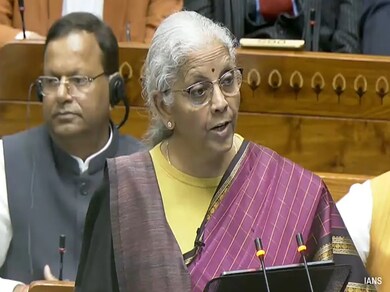
Source NDTV
NEW DELHI — In a historic Sunday session, Finance Minister Nirmala Sitharaman presented the Union Budget 2026-27, laying out a comprehensive ₹53.5 lakh crore roadmap designed to cement India’s position as a global manufacturing and infrastructure powerhouse. Under the theme of the “Reform Express,” the budget focuses on a three-Kartavya (Duty) framework aimed at sustaining economic momentum amid global volatility.
The Infrastructure Engine: ₹12.2 Lakh Crore Capex
The cornerstone of this year’s budget is a massive ₹12.2 lakh crore allocation for capital expenditure (Capex), representing a nearly 9% increase from the previous year.
Rail & Sea: Plans include seven new High-Speed Rail corridors and a dedicated Freight Corridor linking Dankuni (East) to Surat (West).
Waterways: 20 new National Waterways will be developed over the next five years.
Urban Growth: The government will spend ₹5,000 crore per “City Economic Region” to transform Tier-2 and Tier-3 cities into industrial hubs.
Manufacturing 2.0: Semiconductors and Biopharma
The Finance Minister doubled down on “Aatmanirbharta” (Self-reliance) with strategic outlays for frontier sectors:
India Semiconductor Mission (ISM) 2.0: Launched to build a complete ecosystem for chip equipment and materials.
Biopharma SHAKTI: A ₹10,000 crore scheme to turn India into a global hub for biologics and biosimilars.
Electronics: The outlay for the Electronics Components Manufacturing Scheme has been nearly doubled to ₹40,000 crore.
Direct Tax Reforms & Relief
While income tax slabs remained unchanged, the Minister introduced the New Income Tax Act, 2025, effective from April 1, 2026. Key highlights for the common man include:
Revised Returns: The deadline to fix mistakes in tax returns has been extended to March 31.
Travel & Education: Tax Collected at Source (TCS) for overseas tour packages and education/medical remittances has been slashed from 5% to 2%.
Healthcare: Basic customs duty has been exempted for 17 life-saving cancer drugs, significantly lowering treatment costs.
“The Reform Express is well on its way. Our goal is to sustain structural reforms that are adaptive, forward-looking, and inclusive,” FM Sitharaman stated during her record ninth consecutive budget speech.
Fiscal Prudence and Market Impact
The government signaled its commitment to fiscal discipline by targeting a fiscal deficit of 4.3% of GDP for FY27, down from 4.4%.
Key Metric 2025-26 (Projected) 2026-27 (Target)
Total Expenditure ₹48.2 Lakh Cr ₹53.5 Lakh Cr
Capital Expenditure ₹11.2 Lakh Cr ₹12.2 Lakh Cr
Fiscal Deficit 4.4% 4.3%
Debt-to-GDP Ratio 56.1% 55.6%
However, the markets reacted with caution to a hike in the Securities Transaction Tax (STT). STT on futures was raised to 0.05%, while the tax on options premiums increased to 0.15% to curb speculative trading.
A Focus on the Future
The budget also introduced the “She-Mark” scheme to support women entrepreneurs and the Digital Knowledge Grid to create high-end research jobs. With the 16th Finance Commission report now tabled, the government aims to devolve ₹1.4 lakh crore to states to ensure growth is balanced across all regions.