Source TOI
What began as a targeted call to gather at New Delhi’s famous Jantar Mantar quickly turned into a nationwide wave of spontaneous demonstrations. The “Jantar Mantar 2.0” protest, called by the civil group CJP over alleged voter roll deletions, outgrew its original ground the moment police stopped crowds from reaching it. Instead of stopping the movement, road closures and heavy security pushed thousands of demonstrators into streets, squares, and public spaces across major Indian cities.
A Capital Sealed Behind Barricades
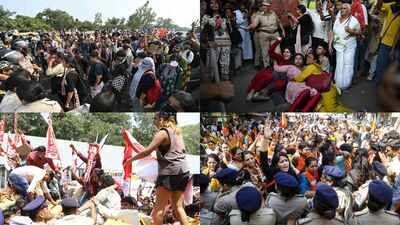
In Delhi, authorities denied permission for the gathering, pointing to security and traffic concerns. By morning, around 35,000 security personnel lined the streets, setting up checkpoints and metal barricades while flying surveillance drones overhead. Dozens of metro station gates were closed, and internet access was curbed in surrounding areas to stop crowds from organizing.
Organizers, political figures, and prominent commentators—including CJP founders Abhijeet Dipke and Saurav Das, AAP leader Arvind Kejriwal, and YouTuber Dhruv Rathee—were detained before they could even step foot on the protest grounds. Yet, the restrictions created unintended ripple effects. Blocked from reaching Jantar Mantar, smaller groups stood their ground at major junctions, holding up signs near Minto Bridge, Connaught Place, and local transit hubs.
Crowds Spill into Other Cities
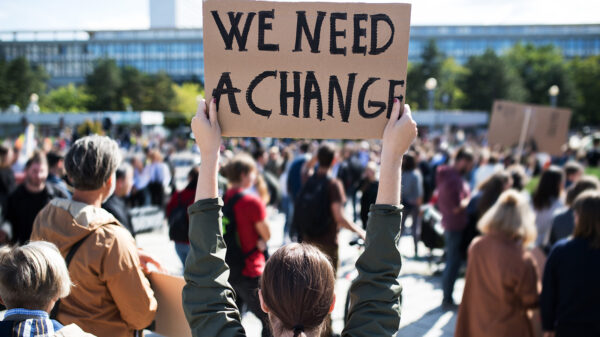
As images of blockades and detentions spread across social media, solidarity rallies quickly surfaced outside the capital. With no central leader directing the crowds on the ground, everyday citizens and regional organizations gathered at local landmarks.
In Mumbai, hundreds took to historic public spaces like August Kranti Maidan and Hutatma Chowk. Over 600 people were detained in the city, including Mahatma Gandhi’s great-grandson, Tushar Gandhi, and Bollywood actor Imran Khan. Similar demonstrations sprang up in Bengaluru near Freedom Park, as well as in parts of Ahmedabad and Chandigarh, where demonstrators marched against the curbs and called for institutional accountability.
When a Blockade Backfires
The movement originally aimed to press for an inquiry into the election commission’s voter revision drive. However, the sweeping crackdowns shifted public attention to the right to assemble peacefully. Opposition parties accused the government of silencing dissent, while ruling officials called the demonstrations an unlawful disruption to daily life.
By evening, most detained protesters were let go, but the nature of the protest had clearly changed. When authorities closed off Jantar Mantar, they left demonstrators without a single destination. Instead of quieting down, the protest scattered across neighborhoods and state lines, proving that a movement does not always need a single address to make itself heard.
For a closer look at the heavy security arrangements and on-ground scenes in the capital, watch the Jantar Mantar ground report. This video provides real-time reporting and visuals showing how security measures unfolded around the protest site.