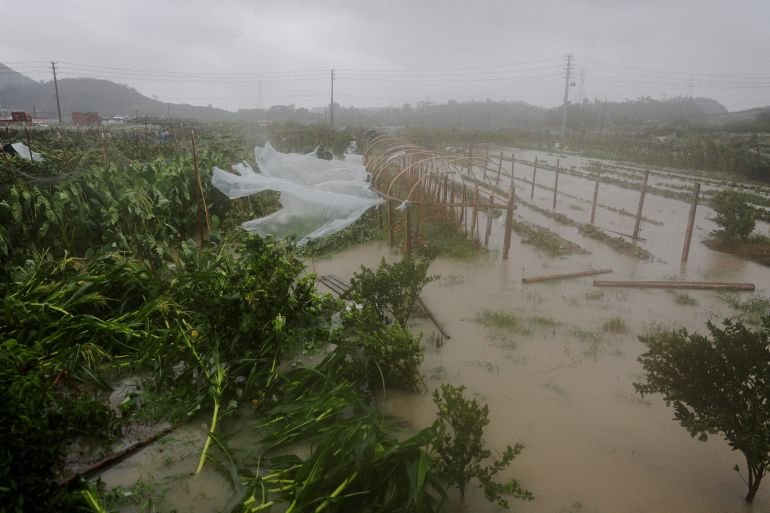
Source Aljajeera
BEIJING — One of the most powerful storm systems to threaten mainland China this year made landfall late Saturday night, forcing the evacuation of nearly three million people and grinding transportation networks to a near-total halt across the nation’s eastern economic hubs.
While Typhoon Bavi has since weakened into a severe tropical storm as it pushes further inland, meteorological authorities warn that the danger is far from over. Torrential rain, violent winds, and severe flood risks continue to loom over heavily populated coastal and northern provinces.
Double Landfall in Zhejiang Province
The storm first slammed into the coastal city of Yuhuan in eastern China’s Zhejiang province at around 11:20 PM local time on Saturday, packing maximum sustained winds of 144 km/h (89 mph) near its center. Sweeping northwestward, Bavi made a second landfall in nearby Yueqing shortly after midnight before gradually losing wind intensity over the rough terrain.
Local residents described a night of intense anxiety as the storm tore through coastal infrastructure.
“The winds were incredibly powerful,” said Li Liangxing, a resident of Yueqing. “We could hear roof tiles shattering and tree branches snapping all night. We live by the sea so we are used to storms, but I have never seen the water rise this high.”
In Yueqing alone, state broadcaster CCTV reported that more than 1,300 trees were knocked down, with hundreds entirely uprooted. Floodwaters quickly submerged streets, transforming urban roads into murky canals.
Unprecedented Evacuations and Travel Gridlock
Anticipating severe devastation, Chinese authorities executed one of the largest preemptive disaster response operations of the year. More than 2.8 million residents were successfully relocated from flood-prone and high-risk zones across eastern China, including over 2.2 million people in Zhejiang province alone. In nearby Shanghai, officials moved 34,000 residents to temporary shelters.
The mass safety measures severely disrupted the peak summer travel season, causing widespread cancellations across rail, air, and sea networks:
Air Travel: More than 1,000 flights were grounded. Shanghai alone saw 684 flight cancellations, while Hangzhou’s Xiaoshan International Airport scrapped over 320 flights.
Railways: Major transit hubs suspended operations, with over 1,600 train trips canceled across Shanghai and Zhejiang.
Public & Tourism Closures: Ferry services were completely halted, and dozens of major tourist attractions and scenic sites in Shanghai were shuttered.
To aid immediate emergency rescue and relief efforts, the central government allocated 40 million yuan ($5.9 million) in disaster funds to the hardest-hit provinces of Zhejiang and Fujian.
A Trail of Regional Destruction
Before striking mainland China, Bavi left a chaotic trail across East Asia. The storm intensified seasonal monsoon rains in the southern Philippines, triggering deadly landslides that claimed at least 17 lives.
As it swept past Japan’s southern Okinawa islands and tracked north of Taiwan, it dumped nearly 80 cm (31 inches) of rain in parts of northern Taiwan. Taiwanese emergency crews are currently working to clear roads after the storm caused at least 134 injuries, mostly due to wind-blown debris and slippery roads.
Prolonged Flood Risk Ahead
The National Meteorological Center has maintained high alerts, including the year’s first red alert for rainstorms. Forecasters emphasize that while Bavi’s winds are diminishing, its massive, slow-moving rain bands carry an immense volume of tropical moisture.
Moving toward the northwest, the storm system is projected to drop torrential downpours across Anhui, Jiangsu, Shandong, and Hebei provinces, as well as parts of Beijing. Local authorities remain on high alert for secondary disasters, including urban flooding, river overflows, and mudslides in areas already saturated by earlier summer rains.