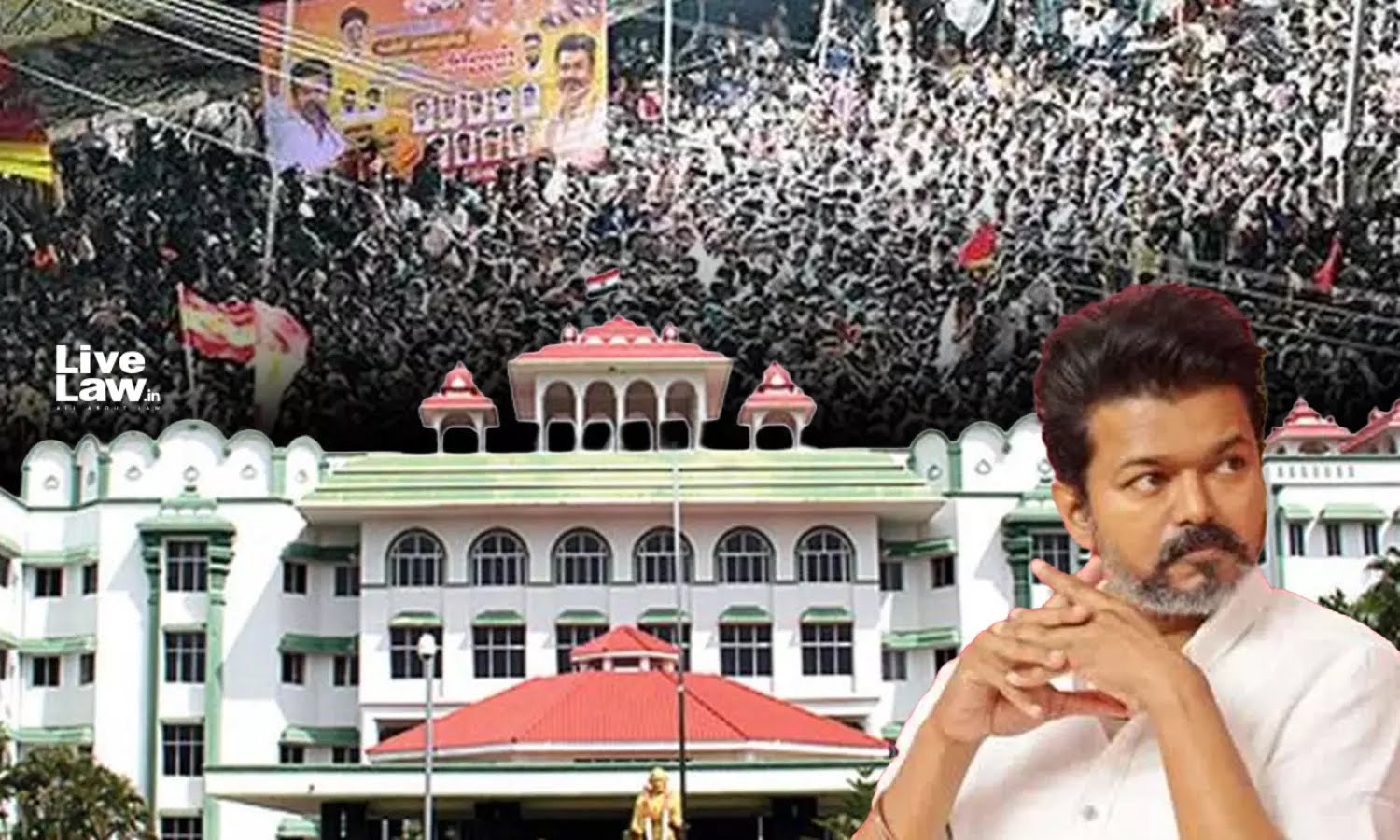
Source Live law
CHENNAI — In a major legal setback for the Tamil Nadu state government, the Madurai Bench of the Madras High Court on Monday set aside a Government Order granting compassionate appointments to the family members of those who died in the 2025 Karur stampede tragedy.
A Division Bench comprising Justice C.V. Karthikeyan and Justice R. Sakthivel ruled that offering government jobs outside the established statutory recruitment process violates Articles 14 and 16 of the Constitution, which guarantee equality before the law and equal opportunity in public employment.
Executive Discretion Has Limits
The court’s decision comes weeks after Chief Minister C. Joseph Vijay handed over government appointment orders to 31 eligible family members of the stampede victims. The tragedy, which occurred during a political gathering in Karur in September 2025, claimed 41 lives and injured dozens.
While acknowledging the deep grief of the affected families, the Bench emphasized that public employment cannot be treated as a form of discretionary monetary or political compensation.
“Public employment is not to be thrown away by the State. It has to be earned. Its value has to be realized. Its importance is to be cherished,” the Bench observed during the ruling, highlighting that thousands of candidates are actively waiting on statutory lists for compassionate appointments or standard public service exams.
Key Reasons Cited by the Bench
Bypassing the Existing Waitlist: The court highlighted that jumping over applicants who have been waiting for years under standard government employee compassionate rules is inherently discriminatory.
Risk of Opening ‘Floodgates’: The Bench noted that using state recruitment as emergency relief creates a dangerous precedent. It observed that victims of other severe accidents—such as industrial firework explosions or transit crashes—are rightfully provided monetary ex-gratia assistance rather than public sector posts.
Constitutional Boundaries (Article 162): While the state argued that the decision fell under its administrative policy executive power, the judges clarified that executive discretion cannot overrule constitutional guarantees of fair competition.
Alternative Rehabilitation Suggested
The High Court clarified that striking down the jobs order does not mean the government cannot assist the grieving families. Instead of public sector employment, the judges suggested that the state consider sustainable alternative support models, such as funding technical degree programs, skill development, and entrepreneurship training to empower the families financially.
The Karur stampede incident remains under active investigation by the Central Bureau of Investigation (CBI), monitored by a Supreme Court-appointed committee. Following the verdict, state government sources indicated they are assessing legal avenues to challenge the ruling before the Supreme Court.