Source earthsky.org
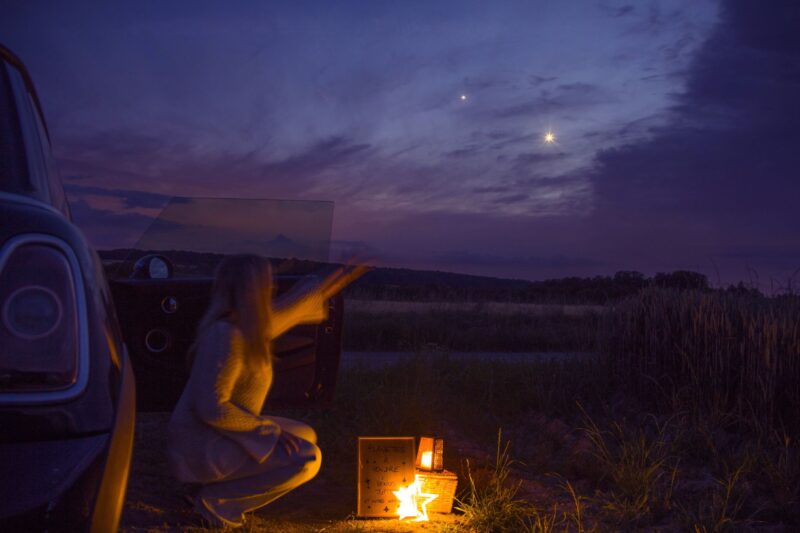
CAPE CANAVERAL — Night skywatchers across the globe were treated to a stunning celestial display this week as Venus and Jupiter—the two brightest planets in our solar system—aligned in a brilliant “cosmic kiss.”
The rare planetary conjunction reached its peak on the evening of June 9, 2026, drawing millions of eyes to the northwestern horizon just after sunset.
A Spectacular Naked-Eye Event
While Venus and Jupiter routinely cross paths from our perspective on Earth, this year’s alignment was particularly striking due to their intense brightness and high visibility. Venus, glowing at a brilliant magnitude of -4.0 as the “Evening Star,” paired beside Jupiter, which shone at magnitude -1.8.
At their closest approach, the two cosmic bodies were separated by a mere 1.6 degrees—roughly equal to the width of three full moons placed side-by-side.
“Venus and Jupiter are truly the stars of the night as darkness falls,” noted Austrian astrophotographer Michael Jaeger, who managed to capture the bright duo alongside a passing stream of Starlink satellites. “What a beautiful pair in the sky.”
A Planetary Illusion
Despite appearing as though they were practically touching, the proximity is entirely a visual illusion caused by their orbital alignment along the ecliptic—the flat plane of our solar system.
In reality, the two planets remain separated by an unfathomable ocean of space:
Venus is currently sitting roughly 110 million miles (180 million kilometers) from Earth.
Jupiter is trailing far behind at approximately 560 million miles (900 million kilometers) away.
Because Venus is much closer to Earth and boasts a highly reflective cloud cover, it easily outshone the gas giant, making it the easier of the two to spot initially in the fading twilight.
The Sky Show Continues
If you missed the peak on June 9, the show isn’t entirely over yet. The two planets will remain within a close five-degree window through mid-June.
Even better, astronomers note that this conjunction kicks off a larger “planet parade.” Over the next few evenings, a faint Mercury will climb slightly higher into the twilight glow, followed by a slender, waxing crescent Moon on June 16 and 17. The addition of the Moon will transform the alignment into a breathtaking celestial quartet.
Skywatchers looking to catch the tail end of the event should find an unobstructed view of the western horizon roughly 30 to 45 minutes after sunset. No special equipment is required, though a standard pair of binoculars will easily fit both planets into a single field of view, occasionally revealing Jupiter’s four largest Galilean moons as tiny pinpricks of light.
Don’t wait too long to look up—Jupiter will continue to sink lower into the sun’s glare each evening, eventually disappearing from view by early July.