Source Tech explosion
In a groundbreaking study, scientists have uncovered new insights into how giant black holes grow, pointing to powerful cosmic collisions as a key driver behind their massive expansion. The research sheds light on one of the most enduring mysteries in astrophysics—how supermassive black holes reached enormous sizes in the early universe.
Astronomers have long observed that black holes, especially those found at the centers of galaxies, can contain millions or even billions of times the mass of the Sun. These colossal entities, known as supermassive black holes, were believed to grow gradually by absorbing gas, dust, and stars over time. However, the latest findings suggest that violent mergers between galaxies—and the black holes within them—play a far more significant role than previously thought.
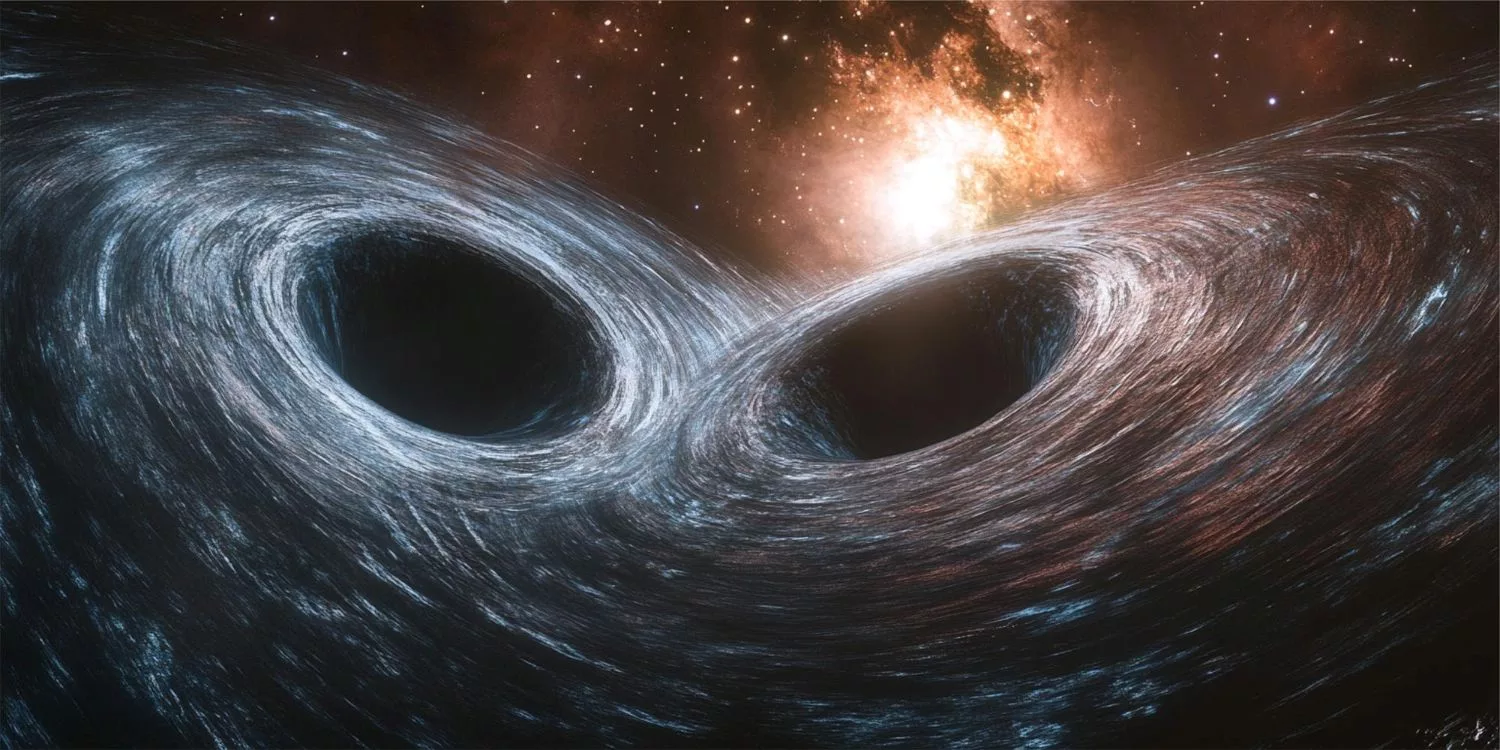
Using advanced simulations and observational data, researchers demonstrated that when galaxies collide, their central black holes are drawn together by gravitational forces. Over time, these black holes merge, forming a single, larger black hole. This process not only increases mass rapidly but can also trigger intense bursts of energy, sometimes outshining entire galaxies.
The study also indicates that these mergers were more common in the early universe, helping explain how supermassive black holes formed so quickly after the Big Bang. Scientists believe that repeated collisions created a chain reaction, enabling black holes to grow at a much faster pace than through steady feeding alone.
In addition to revealing growth mechanisms, the findings have implications for the detection of gravitational waves—ripples in spacetime first predicted by Albert Einstein. Black hole mergers are among the most powerful sources of these waves, and future observatories are expected to detect more such events, offering deeper insights into cosmic evolution.
Experts say this discovery marks a significant step forward in understanding the life cycle of galaxies and the role black holes play in shaping them. As technology advances, scientists hope to observe these cosmic collisions more directly, bringing us closer to unraveling the secrets of the universe.