
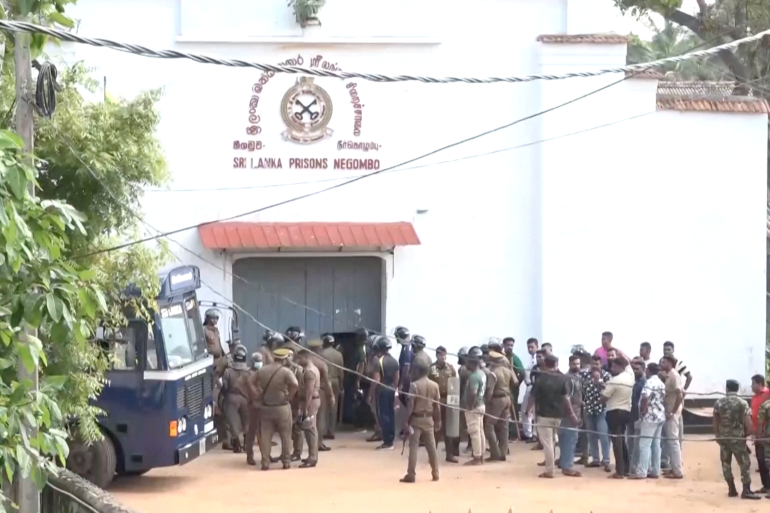
Source Aljajeera
NEGOMBO, Sri Lanka — A horrific wave of violence broke out at a high-security prison facility in the coastal town of Negombo, located roughly 35 kilometers north of the commercial capital, Colombo. Initial reports confirm that at least 25 people have lost their lives, and more than 100 others sustained severe injuries following intensive overnight clashes between rival inmate factions.
The violence reportedly ignited late Sunday evening when tensions boiled over between convicted prisoners and pre-trial detainees. Local police sources indicate the conflict involved deeply entrenched rival drug gangs housed within the heavily congested compound.
The clashes quickly escalated out of control by Monday morning, prompting authorities to call in heavily armed police commandos to surround the facility. The Sri Lankan military has also been placed on standby to assist local law enforcement in restoring order. In an effort to manage the chaotic scene inside, the Sri Lankan Air Force deployed surveillance drones and a helicopter to monitor the unfolding crisis from above.
Hospital Director Pushpa Gamlath confirmed that the local state-run Negombo hospital received the bodies of the deceased, which tragically included four prison guards who were killed while attempting to break up the initial rioting.
“We have admitted more than 100 individuals,” Gamlath stated. “Victims are being treated for a range of trauma, including gunshot wounds, deep lacerations, and severe blunt-force injuries.”
As the riots spread through the facility, a desperate secondary protest erupted in the adjacent women’s wing. Dozens of female inmates climbed onto the facility’s roof demanding immediate release. Tragically, a section of the roof collapsed during the demonstration, resulting in multiple additional injuries.
A System at the Breaking Point: This incident marks the deadliest prison riot Sri Lanka has witnessed in over five years. It has once again cast a harsh spotlight on the severe systemic issues plaguing the nation’s correctional network.
The country’s prison infrastructure is notoriously over-capacity. While the entire national system is designed to safely hold approximately 10,000 individuals, official data released just prior to the riots revealed that the actual inmate population has surged past 41,000—operating at nearly four times its intended limit.
Distraught family members have gathered in massive crowds outside the main gates of the Negombo prison, desperately awaiting news of their loved ones as police buses begin transferring batches of inmates to alternative secure facilities across the country. An official government investigation into the exact catalyst of the riot and the security protocols inside the facility is expected to begin immediately.









