
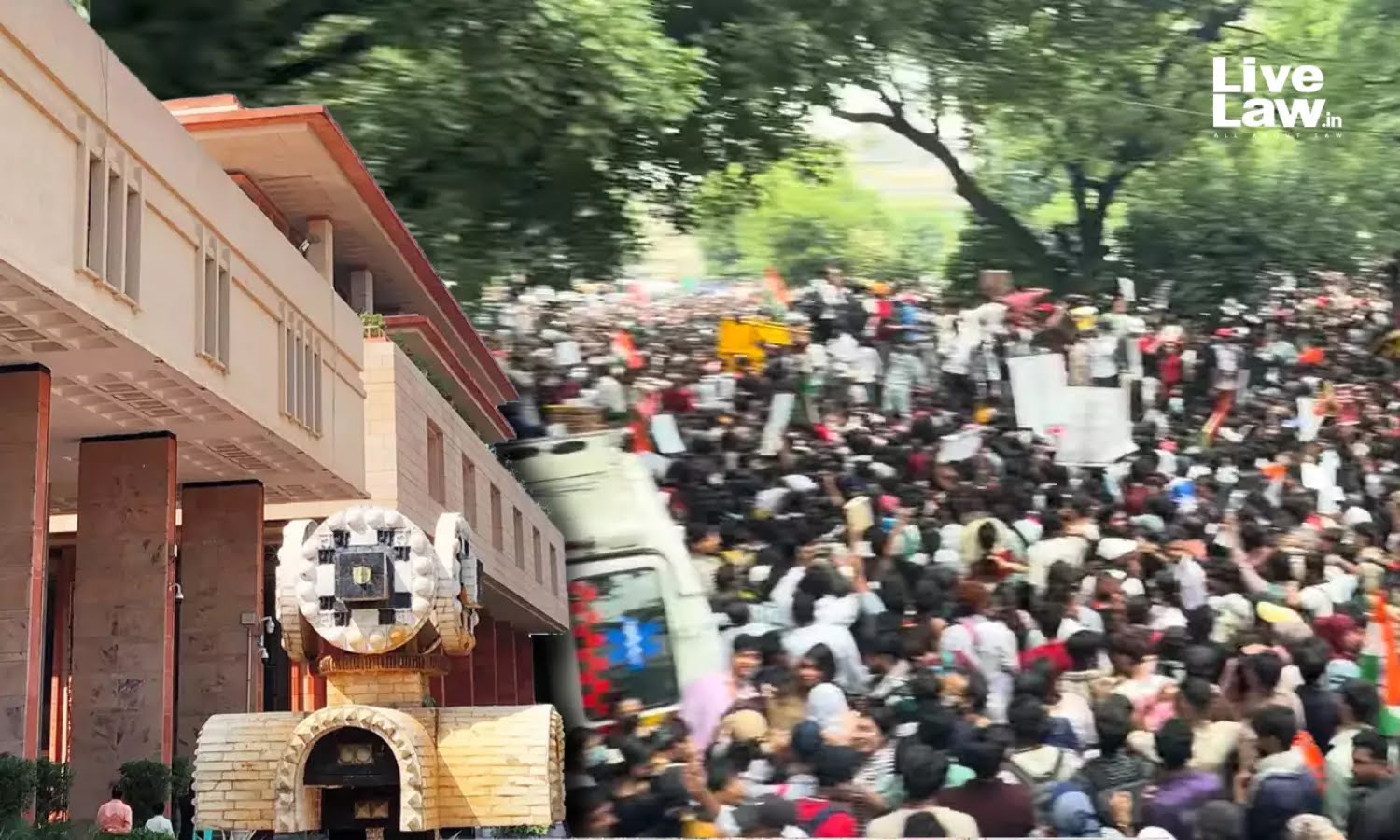
Source Live law
NEW DELHI — The Delhi High Court issued notice to the Delhi Police and the Union Government, demanding a comprehensive response to a batch of Public Interest Litigations (PILs) alleging excessive and disproportionate force against student protesters during the Cockroach Janta Party’s (CJP) “Sansad Chalo” march on July 20.
A Division Bench comprising Chief Justice Devendra Kumar Upadhyaya and Justice Tejas Karia directed law enforcement authorities to file their counter-affidavits within four weeks and ordered the immediate preservation of all relevant digital and physical evidence—including CCTV footage, PCR logs, and official videography—pertaining to the crackdown.
The matter has been set for further hearing on September 11.
High Court Rejects Police Objection on Maintainability
During the proceedings, Additional Solicitor General (ASG) S.V. Raju, representing the Delhi Police and the Central Government, argued that the PILs were not maintainable. He contended that individual demonstrators claiming injury or assault should approach local magistrates or file individual police complaints rather than seeking constitutional remedies through public interest litigation.
The bench firmly rejected this line of defense
“Is it a case of some isolated individual incidents? Perhaps no. If it was an unlawful assembly, as you say, subject to further submissions and records, there is a law on how to deal with it… If these issues are being raised in this PIL, how can you say every individual should go and lodge an FIR?”
— Chief Justice D.K. Upadhyaya
Key Allegations Raised by Petitioners
Appearing for the petitioners, Senior Advocates Gopal Sankaranarayanan, Vikas Singh, and Delhi High Court Bar Association President N. Hariharan presented severe allegations of state overreach, citing verified video recordings of the incident:
Unidentifiable Personnel: Several individuals using batons and force were allegedly out of uniform and lacked identification badges.
Disproportionate Weapons: Petitioners claimed officers used laathis fitted with nails and shock-inducing electric batons against non-violent student demonstrators.
Direct Targeting: Allegations were made that tear gas canisters were fired directly at crowds containing women and children, violating Supreme Court protocols that require warnings and dispersal trajectories aimed away from assemblies.
Specific Misconduct: Video evidence submitted to the court allegedly showed senior officers physically assaulting female protesters without provocation.
Police Defense & Clashes on the Ground
Defending the action, ASG Raju submitted that the rally escalated into violence, citing videos where demonstrators allegedly pelted stones and damaged public property.
According to Delhi Police, at least nine First Information Reports (FIRs) have been registered across Parliament Street, Barakhamba Road, and Connaught Place police stations. Charges include rioting, damage to public property, assault on public servants, and an alleged life-threatening attack on a Rapid Action Force (RAF) jawan.
Context of the Demonstration
The July 20 “Sansad Chalo” march was organized to protest alleged paper leaks in the NEET-UG examination. The rally was spearheaded under the umbrella of the Cockroach Janta Party (CJP)—a viral social media movement that gained widespread traction among youth across the country following controversial oral observations made during prior judicial proceedings.
While police maintain that the crowd turned aggressive as it approached Parliament, counsel for the petitioners emphasized that the movement had remained peaceful for nearly three weeks prior to the police intervention.
Summary of Court Directives
AspectHigh Court Order / Status
RespondentsDelhi Police & Union of India
Notice Period4 weeks to file counter-affidavits
Interim OrderPreserve all CCTV footage, PCR logs, and SOP records
Next HearingSeptember 11









