
Source TOI
BEIJING — In the remote expanse of China’s northwestern desert, a sprawling and unprecedented military complex is rapidly taking shape. According to a newly detailed review of satellite imagery, Beijing is constructing a vast network of hardened infrastructure explicitly designed to insulate its nuclear forces against a potential preemptive strike.
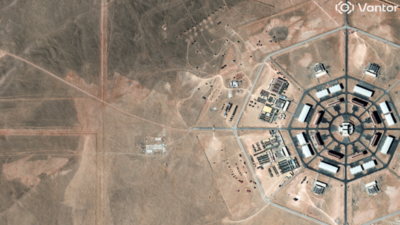
The defense expansion is centered near the isolated Hami intercontinental ballistic missile (ICBM) silo fields in eastern Xinjiang. The newly uncovered network features more than 80 concrete launch pads and a series of massive, geometric military installations that have caught global security analysts by surprise.
Shielding the Second Strike
At the heart of this sprawling desert network are three large, octagon-shaped complexes built over the last six years. Two of these heavily fortified installations sit between 140 and 230 kilometers southwest of the Hami silo fields, while a third, less-developed octagonal site further south near the Lop Nur nuclear test facility appears to function as a military target range featuring mock-ups of Western fighter jets.
Security scholars who analyzed the imagery for Reuters indicate that this massive layout is aimed at securing China’s “second-strike” capability—ensuring that even if the United States or another adversary launched a first-strike attack on China’s fixed nuclear silos, Beijing would retain the infrastructure and mobile units necessary to retaliate.
While China’s nuclear arsenal already holds the capability to strike any major city in the United States, this construction signals a major shift toward strategic survivability and force diversification.
“We can see this infrastructure is being built on a grand scale, covering thousands of square kilometers of desert beyond the silo fields,” noted Alexander Neill, an adjunct fellow at Hawaii’s Pacific Forum think tank. He described the development as a “very considerable enhancement” of China’s strategic nuclear deterrent.
Concrete Pads and Hidden Conduits
The satellite imagery reveals a highly organized web of dirt roads and conduits radiating outward from the main octagonal hubs deep into the rocky desert terrain. These paths terminate at more than 80 reinforced concrete pads hidden among dry creek beds and rocky outcrops.
Military experts suggest these dispersed pads serve multiple strategic purposes:
Mobile Missile Deployment: Some of the larger concrete pads are sized appropriately to host road-mobile ICBM launchers, allowing China to rapidly move its longest-range missiles out of predictable silos.
Air Defense Cover: The pads provide stable, pre-surveyed positions for mobile air-defense missile batteries to shield the airspace over the nuclear fields.
Electronic Warfare: Several sites appear positioned to host electronic warfare units designed to jam enemy communications and radar systems during a conflict.
Furthermore, analysts point to heavy construction at the northernmost octagon, where two large towers and satellite dishes are being erected. Experts believe these are part of a highly secure Command, Control, and Communications (C3) system, likely linked by fiber-optic cables buried within the desert conduits to prevent interception.
“An Extraordinary Effort”
The sheer scale of the protective web surrounding the Xinjiang missile fields represents an unusual departure from the traditional infrastructure layouts of other major nuclear powers. Analysts who have spent decades tracking global nuclear storage and deployment systems expressed astonishment at the speed and size of the project.
“I’ve never seen anything quite like it,” said Hans Kristensen, an analyst tracking global nuclear programs. “It’s an extraordinary effort.”
While the Pentagon projects that China’s rapidly growing nuclear arsenal could reach roughly 1,000 operational warheads by 2030, Beijing has consistently maintained that its official policy is strictly defensive, adhering to a strict “no first use” nuclear doctrine. However, this massive desert fortress highlights that while China may promise not to strike first, it is investing billions to guarantee it can strike back.









